
Introduction: Why This Question Matters So Much
If you walk into any supermarket in 2026, you’ll notice something interesting: halal awareness has become mainstream. Muslim consumers are no longer just checking whether meat is halal — they are now carefully analyzing every processed snack, candy, and drink.
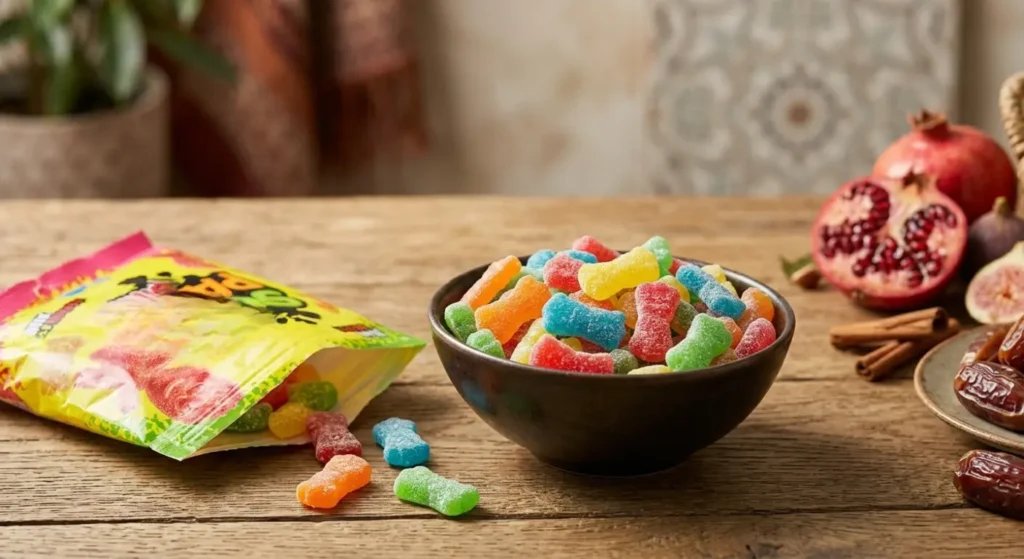
Among the most frequently questioned candies is Sour Patch Kids, a globally popular sour-sweet gummy candy produced by Mondelez International.
The confusion is understandable. On the surface, Sour Patch Kids look harmless — fruit-flavored, colorful, and gelatin-like in texture. But in Islamic dietary law, appearance does not determine permissibility. Ingredients and processing matter deeply.
So the real question is:
Is Sour Patch halal or haram in Islam?
The answer is not a simple yes or no. It depends on ingredients, regional formulas, and how strictly one follows halal guidelines. Let’s break it down properly.
Understanding the Islamic Standard for Halal Food
Before analyzing the candy itself, we must understand what “halal” actually means in Islamic law.
For food to be considered halal, it must meet these conditions:
No Haram Ingredients
- Pork or pork-derived substances
- Alcohol or intoxicants
- Non-halal animal derivatives
Proper Source of Animal Ingredients
If animal-based ingredients are used:
- They must come from halal-slaughtered animals
Clean Processing
- No cross-contamination with haram substances (for strict interpretations)
Transparency
- Ingredients should be identifiable and traceable
With this framework in mind, we can now evaluate Sour Patch Kids properly.
What Are Sour Patch Kids Made Of?
Sour Patch Kids are chewy candies with a sour sugar coating and a soft gummy center.
A typical ingredient list (U.S. version) includes:
- Sugar
- Invert sugar
- Corn syrup
- Modified corn starch
- Citric acid
- Tartaric acid
- Natural and artificial flavors
- Artificial colors (Red 40, Yellow 5, Blue 1)
- Carnauba wax
Now the key question:
Is there gelatin?
In most modern formulations sold in the United States and several other countries:
No gelatin is used.
Instead, the texture is created using:
- Corn-based starches
- Pectin or plant-derived stabilizers
This is extremely important because gelatin is usually the biggest halal concern in gummy candies.
Why Gelatin Is the Main Concern in Candy
Gelatin is a protein derived from collagen found in animal skin and bones.
It can come from:
- Pork (haram unless certified halal — usually not accepted)
- Beef (only halal if properly slaughtered)
Many gummy candies use gelatin for:
- Chewiness
- Elastic texture
- Moist mouthfeel
But Sour Patch Kids generally avoid gelatin entirely, which is a strong positive indicator for halal permissibility.
The Real Issue: “No Gelatin” Does NOT Automatically Mean Halal
Even though Sour Patch Kids are often gelatin-free, halal status is not determined by one ingredient alone.
We still need to examine other factors:
1. Natural and Artificial Flavors (The Grey Area)
One of the most debated ingredients is:
“Natural flavors”
This term is intentionally broad in the food industry.
It can include:
- Fruit extracts
- Plant-based essences
- Synthetic flavor compounds
- Rarely, animal-derived enzymes
However, in candies like Sour Patch Kids:
- There is no public evidence of pork-derived flavoring
- Most flavors are synthetic or plant-based in practice
Still, because companies are not fully transparent, strict halal consumers may see this as uncertainty (shubhah).
2. Artificial Colors and Additives
Sour Patch Kids contain synthetic dyes such as:
- Red 40
- Yellow 5
- Blue 1
These are:
- Petroleum-derived
- Chemically synthesized
- Not animal-based
From an Islamic perspective:
- Most scholars consider them halal unless proven harmful or contaminated
So colorants are generally not a halal issue.
3. Cross-Contamination in Manufacturing
Even if ingredients are halal, production matters.
Large corporations like Mondelez International often operate shared facilities that produce:
- Gelatin-based gummies
- Chocolate products
- Other processed snacks
This raises a concern for strict halal observers:
- Shared equipment may lead to trace contamination
However:
- Many Islamic scholars consider trace contamination negligible unless proven significant
Related post : Is Naya Halal or Haram?
Regional Differences: Why Your Country Matters
One of the most misunderstood facts about Sour Patch Kids is that they are NOT identical worldwide.
United States & Canada
- Usually gelatin-free
- Often considered halal-friendly by ingredient analysis
Europe
- Slight variations in formulation exist
- Always check label carefully
Muslim-majority countries
- Often require halal certification before import approval
- Some versions are specifically reformulated for halal compliance
This means:
A “halal-safe” Sour Patch in one country may not be identical elsewhere.
So, Is Sour Patch Halal or Haram?
Let’s give a clear, balanced ruling:
Generally:
Most Sour Patch Kids are considered halal-friendly based on ingredients, because:
- No gelatin (in common versions)
- No alcohol listed
- No pork-derived ingredients declared
However:
They are NOT officially halal certified in most markets, which creates uncertainty.
Islamic Classification Summary:
| Category | Status |
|---|---|
| Gelatin | Not present (in most versions) |
| Alcohol | Not listed |
| Animal ingredients | Not confirmed |
| Certification | Usually missing |
| Final ruling | “Likely halal, but not fully certified” |
Scholarly Perspective (Important Insight)
Islamic scholars generally apply three principles here:
Certainty Over Doubt
If an ingredient is clearly halal → permissible
Doubtful Matters
If unclear sourcing exists → avoid if you want strict adherence
Modern Food Industry Reality
Many scholars recognize:
- Synthetic additives are generally permissible unless harmful or clearly haram
So Sour Patch Kids fall into:
“Mubah (permissible) unless proven otherwise” with caution due to certification absence
Are Sour Patch Kids Haram?
They are not inherently haram because:
- No confirmed pork gelatin
- No explicit alcohol ingredients
- No direct haram substances listed
However, they may become questionable if:
- A regional version contains gelatin
- A strict halal certification requirement is followed
So the ruling is not absolute.
Related post : Are Gushers Halal?
Health Reality Check (Often Ignored)
Even if halal:
- Extremely high sugar content
- Acidic coating can damage enamel
- Artificial additives used
So moderation is important not only spiritually but physically.
Halal Alternatives (Safer Choices)
If you want zero uncertainty, consider:
- Halal-certified gummy candies (Middle Eastern brands)
- Agar-agar based gummies
- Fruit leather snacks
- Natural dried fruits (dates, mango, apricot)
These remove doubt entirely.
Final Verdict: Clear Answer
Sour Patch Kids are generally considered halal-friendly in terms of ingredients, but not universally certified halal.
You can consider them halal if:
- You follow ingredient-based halal reasoning
- No gelatin is confirmed on the label
You should avoid them if:
- You require strict halal certification
- You prefer zero-doubt consumption
Final Thoughts
The reality of modern processed food is that halal decisions are rarely black and white anymore. Products like Sour Patch Kids exist in a gray zone shaped by global manufacturing complexity.
The most responsible approach is not fear, but awareness:
- Read labels carefully
- Understand regional differences
- Choose according to your level of halal strictness
That is ultimately how informed Muslim consumers navigate today’s food industry.
