
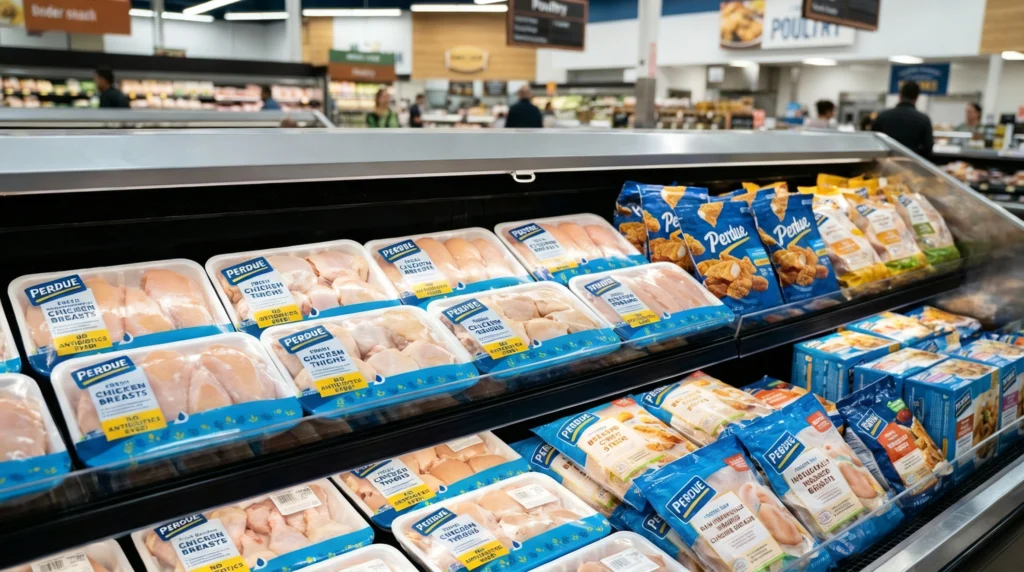
For Muslims living in the United States and other non-Muslim majority countries, one of the most practical yet sensitive daily concerns is food verification. Unlike in Muslim-majority regions where halal availability is widespread and clearly labeled, many Western food systems are built without Islamic dietary requirements in mind.
Chicken is one of the most consumed proteins globally, and it is often assumed to be “safe” or “neutral.” However, in Islam, chicken is not automatically halal simply because it is poultry. The method of slaughter, religious invocation, and processing conditions determine its permissibility.
Among the most widely available poultry brands in the United States is Perdue Farms, commonly known simply as Perdue Chicken. It is present in supermarkets, restaurants, and frozen food sections across the country, making it a highly accessible option for consumers.
This raises a critical and frequently asked question:
Is Perdue chicken halal according to Islamic dietary law?
To answer this properly, we must analyze not only the product itself but the entire industrial system behind it—including farming practices, slaughter methods, processing technology, certification status, and Islamic legal interpretation.
Understanding Perdue Chicken in the Modern Food Supply Chain
Perdue Farms is one of the largest vertically integrated poultry companies in the United States. The term “vertically integrated” is important because it means the company controls almost every step of production, rather than sourcing from independent halal or local suppliers.
This system includes:
- Breeding and raising chickens in large-scale industrial farms
- Managing feed, growth cycles, and farm conditions
- Transporting live birds to processing facilities
- Slaughtering chickens in high-speed industrial plants
- Processing meat into retail-ready products
- Packaging and distributing nationwide
Perdue products include a wide range of items such as whole chickens, chicken breasts, wings, frozen portions, and heavily processed items like nuggets and breaded strips.
While this system is highly efficient and designed for mass production, it is important to understand that efficiency and halal compliance are not the same thing. Industrial food systems prioritize speed, cost reduction, and uniformity, whereas halal requirements prioritize religious compliance and specific slaughter ethics.
What Islam Requires for Chicken to Be Halal
To properly evaluate whether Perdue chicken is halal, it is essential to understand the Islamic framework for halal poultry.
In Islamic law, chicken is only considered halal if all of the following conditions are met:
- The chicken must be alive and healthy at the time of slaughter
- The slaughter must be performed by a Muslim or validly permitted person
- The name of Allah must be mentioned during the slaughter process
- A sharp cut must be made to the throat, windpipe, and blood vessels
- The blood must be completely drained from the body
- The process must be intentional and compliant with Islamic guidelines (zabiha)
If even one of these conditions is not fulfilled, the meat is not considered halal.
This framework is strict because it is based on direct religious instruction rather than general food safety or quality standards.
How Perdue Chicken Is Slaughtered and Processed
In standard US poultry processing systems, including Perdue facilities, the slaughter process is designed for high-speed industrial output rather than individual religious compliance.
The typical process includes:
- Chickens are collected in bulk and transported to processing plants
- Birds are hung upside down on automated conveyor systems
- Electrical or mechanical stunning is applied before slaughter ⚠️
- A mechanical blade performs slaughter in a continuous system
- Carcasses move through cleaning, scalding, and processing stages
- Meat is packaged for distribution in large-scale operations
From an Islamic perspective, several critical issues arise here:
First, there is no individual slaughter performed with intention for each animal. Instead, the system is continuous and mechanical.
Second, the name of Allah is not recited during slaughter, which is a key requirement in zabiha slaughter.
Third, stunning is commonly used before slaughter, which raises scholarly debate but is widely considered problematic when not controlled according to Islamic standards.
Finally, the entire system is designed for industrial efficiency rather than religious compliance, which means halal requirements are not integrated into the process.
Halal Certification Status of Perdue Chicken
Halal certification is one of the most important indicators for Muslims living in non-Muslim countries. It serves as a third-party verification that food meets Islamic dietary requirements.
Certified halal systems typically include:
- Inspection of slaughter facilities by Islamic authorities
- Verification of slaughter method (zabiha compliance)
- Monitoring of ingredient sourcing and processing aids
- Prevention of cross-contamination with non-halal products
- Continuous audits and compliance checks
When we evaluate Perdue Farms:
- There is no halal certification for its chicken products ❌
- No Islamic supervisory authority is involved ❌
- No dedicated halal slaughter line exists ❌
- No zabiha verification system is in place ❌
This means there is no external religious guarantee that Perdue chicken meets halal requirements.
Processed Chicken Products and Additional Concerns
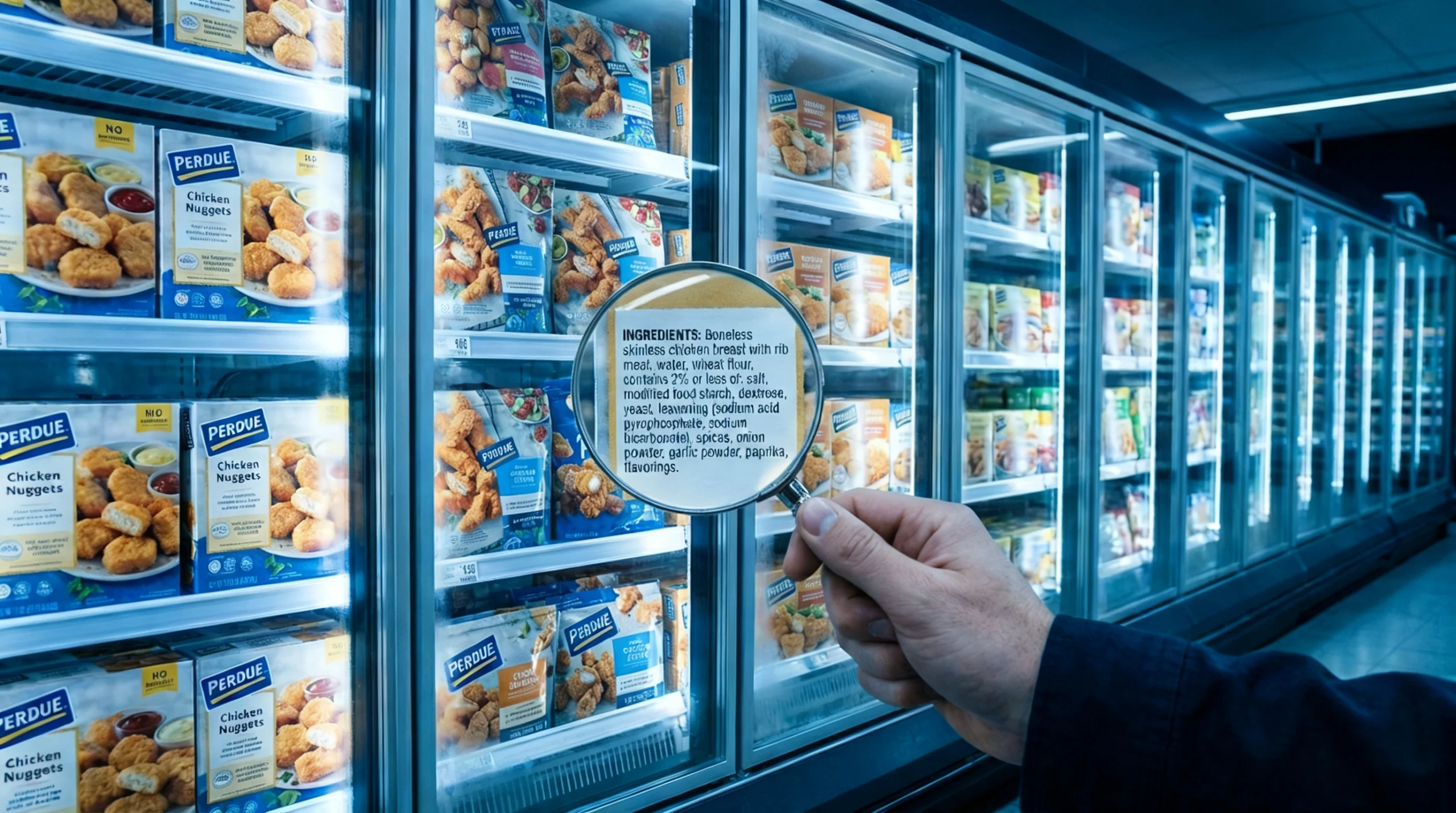
Beyond raw chicken, Perdue also produces a wide variety of processed foods such as:
- Chicken nuggets
- Chicken patties
- Breaded chicken strips
- Pre-seasoned frozen meals
These products introduce additional complexity because they contain:
- Flavor enhancers and seasoning blends ⚠️
- Binding agents and stabilizers ⚠️
- Enzymes or processing aids from unclear sources ⚠️
- Industrial oils used in frying or coating ⚠️
In processed foods, even if the base meat were acceptable (which in this case it is not), the additional ingredients and processing methods create further uncertainty.
From a halal perspective, processed foods always carry higher risk than raw, certified meat.
Related post : Are Nerds Gummy Clusters Halal?
Cross-Contamination Risks in Industrial Facilities
Another important factor is cross-contamination, which occurs when halal and non-halal products share the same environment.
In large-scale facilities like Perdue:
- Multiple product types are processed in the same plant ⚠️
- Equipment is shared between different meat categories ⚠️
- Cleaning processes may not guarantee complete separation ⚠️
- Storage and packaging systems are integrated ⚠️
Even if someone tries to separate concerns about ingredients alone, contamination risk remains a serious consideration in Islamic law, especially when certainty is absent.
Detailed Halal Evaluation Table
Table 1: Perdue Chicken Halal Assessment Overview
| Category | Status | Explanation |
|---|---|---|
| Slaughter method | ❌ Not halal | No zabiha process used |
| Religious invocation | ❌ Not performed | No “Bismillah” recited |
| Certification | ❌ None | No halal authority approval |
| Raw chicken | ❌ Not halal | Same industrial system |
| Processed products | ❌ Not halal | Additives + contamination risk |
| Facility system | ⚠️ Mixed | Non-halal integrated production |
Islamic Scholarly Understanding
Most mainstream Islamic scholars and halal certification bodies agree on a consistent principle: meat must be slaughtered according to Islamic law to be considered halal.
Key points include:
- Proper slaughter is mandatory for permissibility ❌
- Industrial slaughter without invocation is not considered zabiha ❌
- Stunning is only acceptable under strict conditions that are not met in most commercial systems ⚠️
- Certification is required in non-Muslim countries to ensure certainty ⚠️
A foundational principle in Islamic jurisprudence states:
Certainty is not removed by doubt.
Since Perdue chicken does not provide certainty of halal compliance, it is classified as non-halal under mainstream interpretation.
Common Misunderstandings Among Consumers
Many people unintentionally assume incorrect ideas about chicken in Western markets:
- “Chicken is automatically halal unless it contains pork” → ❌ Incorrect
- “Government food safety approval means halal compliance” → ❌ Incorrect
- “Organic or natural chicken is halal” → ❌ Incorrect
- “Clean production means religious compliance” → ❌ Incorrect
These misunderstandings often lead to accidental consumption of non-halal meat.
Comparison with Halal-Certified Chicken
Table 2: Perdue vs Certified Halal Chicken
| Feature | Perdue Chicken | Halal-Certified Chicken |
|---|---|---|
| Slaughter method | Industrial non-zabiha ❌ | Islamic zabiha method ✅ |
| Allah’s name invoked | No ❌ | Yes ✅ |
| Certification | None ❌ | Certified halal authority ✅ |
| Facility separation | Mixed systems ⚠️ | Dedicated halal lines ✅ |
| Ingredient transparency | Partial ⚠️ | Fully verified ✅ |
| Muslim suitability | Not suitable ❌ | Fully suitable ✅ |
Are There Any Halal Options from Perdue?
As of 2026:
- No halal-certified Perdue products exist ❌
- No Islamic slaughter partnerships exist ❌
- No zabiha-compliant production lines exist ❌
This applies across all product categories, including fresh, frozen, and processed chicken.
Practical Guidance for Muslim Consumers
For Muslims in the US or similar markets, the safest and most reliable approach is:
- Buy from certified halal butcher shops
- Look for recognized halal certification labels
- Verify zabiha slaughter explicitly
- Avoid mainstream poultry brands without certification
- Prefer halal-specialized suppliers whenever possible
This removes uncertainty and ensures religious compliance.
Related post : Is Greggs Halal?
Final Verdict
Is Perdue Chicken Halal?
No — Perdue chicken is not halal ❌
Reason Summary:
- No Islamic slaughter method ❌
- No halal certification ❌
- Industrial automated processing ❌
- No religious oversight ❌
- Cross-contamination risks ⚠️
Final Conclusion:
Perdue chicken does not meet Islamic dietary requirements and should not be considered halal under mainstream scholarly standards.
FAQs
Is Perdue chicken halal in the USA?
No ❌ it is not halal-certified.
Does Perdue use Islamic slaughter?
No ❌ industrial methods are used.
Can Muslims eat Perdue chicken?
Not according to strict halal guidelines ❌
Is organic Perdue chicken halal?
No ❌ organic does not affect slaughter method.
Are any Perdue products halal-certified?
No ❌ none exist as of 2026.
Conclusion
Perdue is a major poultry producer with strong industrial efficiency and food safety standards, but it does not operate within Islamic dietary requirements. Without halal certification and proper zabiha slaughter, its chicken cannot be considered permissible for Muslim consumption.
For Muslims seeking certainty in their diet, the only reliable option is verified halal-certified poultry from trusted Islamic sources.When certainty is missing, halal cannot be assumed
