
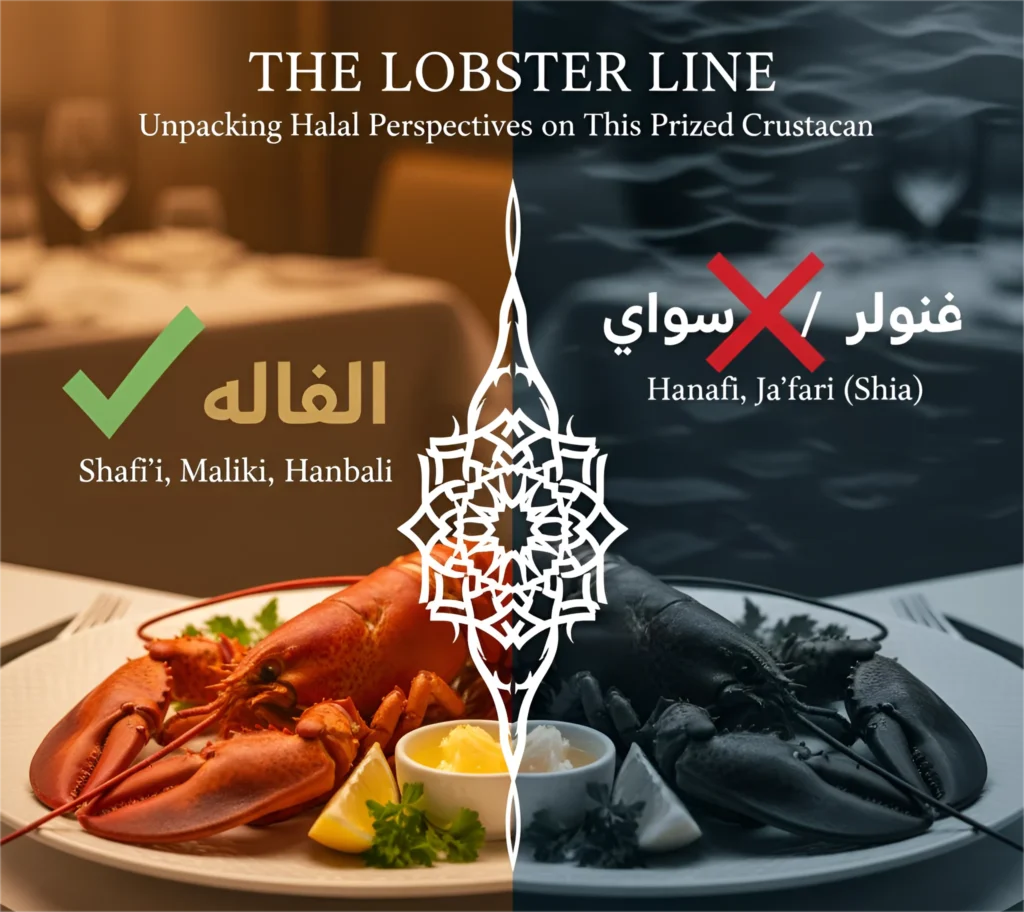
Halal or Haram? Uncovering the Islamic Debate about Lobster
You’re having dinner at a fancy restaurant or a beachside eatery, and the headliner of the menu is lobster. You’re Muslim, and so familiar a query recurs, one that has been debated in homes and corridors of learning for centuries: “Is lobster halal?”
Unlike the unequivocal ban on pork or alcoholic beverages, the response for seafood, most notably crustaceans, is one of the most famous instances of ikhtilaf (scholarly difference) in Islamic law, or fiqh. Whether a Muslim may consume lobster is not a simple “yes” or “no” for everyone. It is a decision arrived at depending on which school of Islamic law (madhhab) is followed.
This piece will be a close examination of this interesting debate, with a look at the scriptural basis and the careful argumentation employed by the various schools of thought as they reach their decisions.
The Scriptural Starting Point: What are the General Rules for Seafood?
All Islamic legal views start with the two main sources: the Qur’an and the Sunnah (Prophetic traditions). For seafood, both sources give a strong, general permission.
- Qur’anic Guidance:
In Surah Al-Ma’idah (5:96), Allah (SWT) declares: “Lawful to you is game from the sea and its food as provision for you and the travelers.” - Guidance from the Sunnah (Hadith):
One of the most well-known hadith, narrated by Abu Hurayrah, states that a man inquired from the Prophet Muhammad (peace be upon him) regarding the sea. The Prophet (pbuh) responded:
> “Its water is purifying, and its dead (animals) are lawful (halal).” (Reported by Al-Tirmidhi, Abu Dawood, and others – Sahih)
These two sources appear to grant an overall, blanket authorization. “Game from the sea” (sayd al-bahr) and “its dead are lawful” (meaning no ritual slaughter is required) appear to legalize everything in the sea.
But the whole issue of lobster turns on the definition of such broad words. Does “game from the sea” include everything that exists in water, or is a general word limited and defined by other evidence?The various madhhabs have answered this question differently, and hence the diverging rulings.
The “Fish-Only” Interpretation: The Hanafi Ruling on Lobster
For those Muslims who adhere to the Hanafi school of jurisprudence, the response to “is lobster halal?” is generally no, it is Haram (forbidden) or at least Makruh Tahrimi (prohibitively disliked).
The Hanafi madhhab is found in Turkey, Pakistan, India, Bangladesh, Central Asia, and in the Balkans. Its rationale for this prohibition involves a special legal methodology.
Why is Lobster Haram in the Hanafi School?
Hanafi authors contend that the blanket permission in the Qur’an (“game from the sea”) has to be understood within the context of other, more specific references.
- Limitation to “Fish” (Samak): Hanafi school believes that other traditions limit the general permission, including the hadith “Two kinds of dead animals have been made lawful for us: fish and locusts.” (Sunan Ibn Majah).
- Linguistic and Traditional Definition: Through this, they deduce that the only type of sea creature which is acceptable is samak, meaning “fish” in Arabic. According to the linguistic and traditional definition of the Arabs during the time of the Prophet (pbuh), a lobster is not a “fish.”
- The Hasharat Analogy: The Hanafi approach frequently means that an unfamiliar animal is identified by its closest equivalent on land. They do not consider a lobster to be akin to a fish because of its hard exoskeleton, legs, and antennae. Rather, it is deemed to be a hasharat (vermin, insect, or “creature of the earth”). It is considered similar to land animals such as scorpions or other crawling insects, which are haram to eat.
- The Principle of Khaba’ith: This is connected to the Qur’anic directive to consume what is Tayyib (good, pure) and abstain from what is Khaba’ith (vile, impure, or repulsive). Animals which are not fish are, according to this categorization, placed in the latter category.
So, for Hanafi followers, the net of “halal seafood” is only thrown over what is correctly categorized as “fish.” That includes lobster, crab, octopus, squid, and shellfish (mussels, clams, oysters). All of these are prohibited.
The Shrimp Exception: It is not uncommon to wonder, then, “Why are shrimp/prawns halal for Hanafis?” This is a special and well-documented exception. The majority of Hanafi scholars allow shrimp because, in spite of appearances, they were commonly recognized and traditionally classified as a type of samak (fish) by the Arabs. This particular customary exception was not applied to lobster or crab.
The “Scales” Requirement: The Shia Ja’fari Ruling on Lobster
Adherents of the Shia Ja’fari school of jurisprudence, which is the most followed school among Shia Muslims, also reach the conclusion that lobster is Haram (forbidden).
Their argument, however, is founded on a different set of facts and an extremely specific legal rule based on the teachings of the Ahlul Bayt (the family of the Prophet and the Imams).
Why is Lobster Haram in the Ja’fari School?
The Ja’fari fiqh regarding seafood is very precise and unambiguous with no scope for doubt.
- The Rule of Scales: As per various authenticated hadith narrated from the Imams (inheritor of the Prophet), the only sea life that can be consumed is in two categories:
- Shrimp/Prawns (irbiyan), which are specially referred to in the narrations as being a permissible exemption.
- Explicit Narrations: Hadith of Imam Muhammad al-Baqir (a.s.) and Imam Ja’far al-Sadiq (a.s.) clearly state: “Eat any fish that has scales, and do not eat that which does not have scales.”
- Lobster Fails the Test: A lobster is a crustacean. It is protected by a hard exoskeleton, or shell, but it lacks fils (scales).
- Not a Shrimp: Although biologically similar, a lobster is not a shrimp, and thus it is not covered under the specific exception.
This definitive rule simplifies it to categorize sea animals. Salmon, trout, and tuna (all are scaled) are halal for followers of the Ja’fari madhhab. Shrimp is halal.
Lobster, crab, squid, octopus, clams, and scaleless animals such as catfish are all haram.
The “All-Encompassing” View: Why Most Scholars Say Lobster is Halal
For the overwhelming majority of Sunni Muslims, adhering to the Shafi’i, Maliki, and Hanbali schools, the reply to “is lobster halal?” is a clear yes, it is completely Halal (permissible).
These three schools predominate in most of the Muslim world, such as Southeast Asia (Indonesia, Malaysia, Singapore), the Middle East (Saudi Arabia, Egypt, Jordan), and North & West Africa.
Why is Lobster Halal for the Majority?
These schools use a more literal and general approach in interpreting the scriptural basis.
- The Qur’an is General: They say Allah’s declaration, “Lawful to you is game from the sea.” (Qur’an 5:96) is an all-encompassing and general authorization. It entails all animals whose major life exists in the sea.
- The Hadith is General: Likewise, the Prophet’s (pbuh) saying, “its dead are lawful,” is interpreted as meaning that all sea animals (which are not poisonous or dangerous) are permissible, and they need no special slaughter.
- No “Fish-Only” Restriction: These schools argue that if Allah (SWT) and His Messenger (pbuh) intended to restrict the permission to only fish, they would have used the specific word samak (fish). The use of the broader term “game of the sea” ($sayd al-bahr$) is seen as deliberate, intended to include all aquatic life.
- The Maliki Position: The Maliki madhhab is notoriously the most liberal in this ruling, declaring that everything from the sea is halal with no exceptions, even animals that can die and float to the surface (which other madhhabs may not approve of).
- Logical Consistency: To these schools, a lobster is a sea-dwelling creature. It is not toxic or poisonous when cooked properly. Hence, it comes squarely under the explicit permission offered in the Qur’an and Sunnah. This logic extends to crabs, shrimps, clams, oysters, squid, and octopus.
For those following these three madhhabs, lobster is not merely allowed but is considered to be among the Tayyibat—the pure and good provisions—allotted to us by Allah from the sea.
Your Practical Questions Answered (Halal FAQ)
The argument about lobster naturally gives rise to other pragmatic queries.
Q: What about surimi/imitation lobster? Is it halal?
This is an extremely frequent query. Imitation lobster (surimi) is generally halal, but YOU MUST read the ingredients.
Imitation lobster is not lobster flesh. Imitation lobster is white fish paste, usually Alaskan Pollock. Pollock is a scaled fish and hence halal in the opinion of all schools of thought, including Hanafi and Ja’fari.
The haram potential arises through the use of additives:
- Mirin (Rice Wine): This is an alcoholic ingredient used to provide taste in some surimi manufacturing.
- Carmine: It is a red food color (or E120 or cochineal) produced using ground insects and is deemed haram by most scholars.
- Other Additives: Ensure there are no alcohol-containing animal-based broths or flavorings.
If the item has halal certification or its ingredient listing has no alcohol, carmine, and other haram substances, it can be consumed by all Muslims.
Q: Does this ruling extend to crab, crayfish, and oysters as well?
Yes. The exact same legal rules that govern lobster apply to other non-fish sea animals:
- Shafi’i, Maliki, Hanbali: They are all halal since they are “game of the sea.”
- Hanafi: They are all haram/makruh since they are not “fish.”
- Ja’fari: They are all haram since they lack scales (and are not shrimp).
Q: I heard that boiling a lobster alive is cruel. Does this render it haram?
This is a significant question that combines fiqh (law) with akhlaq (ethics).
From the purely fiqh point of view, the way it is killed does not make it haram. The hadith “its dead are lawful” implies sea animals are not subject to the rules of dhabiha. Boiled, frozen, or dies in a net, its meat is halal (for schools that allow it).
From an ethics standpoint, Islam requires ihsan (compassion and excellence) in every case, and hence handling of animals. Some Muslims will obtain the most merciful way to kill the animal (such as piercing its brain) before cooking to avoid causing pain, but this is an ethical rather than a legal basis for halal consideration.
Q: My friends belong to a different madhhab. What do we do about it at dinner?
This is a lovely chance to exercise an important Islamic principle: respect for scholarly disagreement.
- If you think it haram (Hanafi/Ja’fari): Politely tell them you will not eat it. A simple, “Thank you, but I don’t consume shellfish because of my dietary requirements,” suffices.
- If you think it halal (Shafi’i/Maliki/Hanbali): You can eat it.
- The Solution: It is essential not to argue about the topic over dinner, or to criticize another Muslim for practicing differently. They are not “wrong” or “less religious”; they are merely adhering to a different, sound, and well-established school of Islamic law.
Conclusion: So, Should You Eat Lobster?
As we can see, the query “is lobster halal?” has no one-size-fits-all response for each of the 1.8 billion Muslims. The reply is, and always was, “It depends on your madhhab.”
- If you belong to the Shafi’i, Maliki, or Hanbali madhhabs, lobster is an acceptable and fine provision from the sea, rendered legal by the overall permissions in the Qur’an and Sunnah.
- If you are a follower of the Hanafi school, lobster is impermissible (haram or makruh) because it is not a “fish,” which is the only category of sea life deemed halal.
- If you are a follower of the Ja’fari school, lobster is impermissible (haram) because it does not have scales, a requirement based on narrations from the Ahlul Bayt.
This disagreement of view is not a weakness, but an aspect of Islamic law, which scholars term a “mercy.” The most significant action for any Muslim is to know the ruling of their own school and adhere to it in faith. If you are not sure what school you belong to, talk to a respected local scholar or imam and ask him to clarify.
For more like this visit : Hilalinfohub
