Is Vanilla Extract Halal? A Complete Guide for Muslims
Introduction: Why the Question Matters
If you’ve ever baked a cake, made cookies, or bought a bottle of perfume, you’ve probably seen vanilla extract listed as an ingredient. It’s one of the most common flavorings in the world — used in ice creams, desserts, pastries, and even drinks.
But for Muslims who practice halal dietary laws, there is one question that arises: Is vanilla extract halal?Vanilla at first glance seems pure — it’s derived from a plant, isn’t it? But the issue is how it’s produced. Commercial vanilla extracts employ alcohol as a solvent, and this makes Muslims question its halal nature.This post delves into all you want to know — from what vanilla extract actually is, to halal-certified alternatives you can safely use in your kitchen.
What Is Vanilla Extract?
Vanilla extract is a seasoning produced by steeping vanilla beans (from the Vanilla planifolia orchid) in a mixture of alcohol and water. This process extracts the flavor compounds, particularly vanillin, which gives the extract its characteristic sweet and pungent taste.
In the majority of nations, pure vanilla extract has to have:
- A minimum of 35% alcohol (as a solvent)
- A minimum of 100 grams of vanilla beans per liter of liquid
That alcohol — typically ethanol — is what fuels the halal controversy.
The Halal Concern: Alcohol in Vanilla Extract
Under Islamic dietary laws, drinking alcohol is strictly haram (forbidden). The Qur’an forbids intoxicants of all types.But scholars disagree about whether alcohol as a processing agent, but not used for getting high, is subject to the same ruling.
How Alcohol Is Used in Vanilla Extract
- Alcohol is only to extract flavor from the vanilla beans.
- The alcohol is in the liquid extract (typically about 35%), but in small amounts when used in baking, most of it evaporates when heated.
However, to most Muslims, the existence of alcohol in any way is a cause for concern — particularly if halal-certified alternatives exist.
Islamic Opinions: Is Vanilla Extract Halal or Haram?
Let’s examine the views of various Islamic scholars and halal certification bodies on this matter.
1. Opinion: Vanilla Extract Containing Alcohol Is Haram
Some scholars maintain that any product with alcohol, no matter what its use or amount, is haram.
They cite the Qur’anic ban on khamr (intoxicants) and maintain that even a trace of ethanol still present makes the product non-halal.
These scholars advise Muslims against consuming common vanilla extract unless it’s certified halal or produced without alcohol.
2. Opinion: Vanilla Extract Is Permissible in Small Quantities
Other scholars approach the subject in a more subtle manner. They contend that the ruling hinges on the source and purpose of the alcohol:
- If the alcohol is not obtained from wine or grapes
- And if it is applied solely for extraction and not used as an intoxicant,
then it could be deemed permissible (mubah), particularly when the ultimate quantity used in food is negligible or burnt off in cooking.
A few halal certification agencies (such as the Halal Food Authority UK) have approved this logic, declaring vanilla extract halal if:
- The alcohol is artificial (not derived from khamr)
- The food is baked or cooked out, eliminating the alcohol content
Scientific Aspect: Does the Alcohol Actually Evaporate?
Some people say that the alcohol in vanilla extract cooks off entirely in baking — but to what extent?
Research by the USDA and Food Chemistry Journal indicates that alcohol does evaporate, but not always entirely. How much remains depends on:
- Cooking time
- Temperature
- Cooking method
For instance:
- Baking or simmering for 1 hour: 85–90% of alcohol are lost
- Baking for 15 minutes: approximately 40% left
- No-heat recipes (such as icing or smoothies): nearly all alcohol is left
Therefore, although the alcohol may largely evaporate when baked, it’s not completely eliminated — yet another reason why Muslims tend to favor halal-certified vanilla.
Halal-Certified Vanilla Extracts: What to Look For
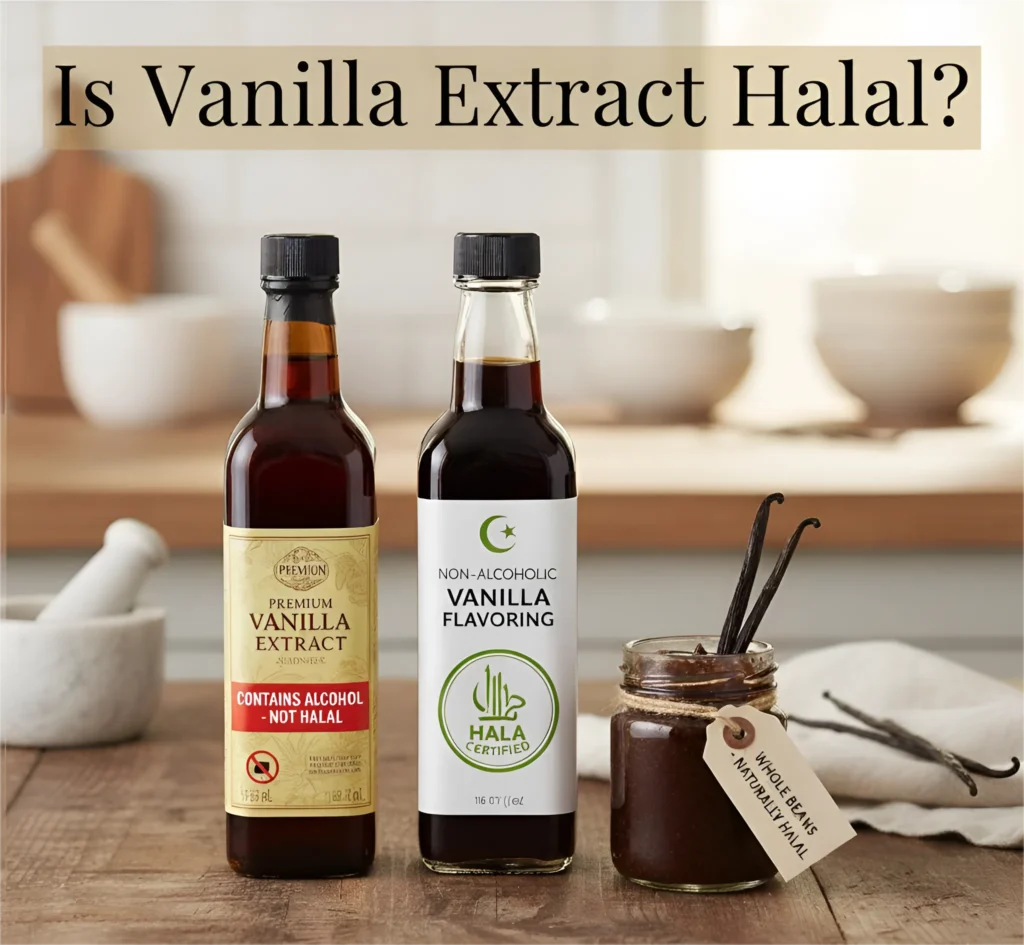
If you want to steer clear of alcohol completely, the good news is that there are now more than enough halal vanilla flavoring alternatives available.
Halal Substitutes for Vanilla Extract
- Halal Vanilla Essence or Flavour
Produced with glycerin or propylene glycol instead of alcohol.
Brands commonly found: Dr. Oetker Natural Vanilla Extract (Halal), Simply Organic Alcohol-Free Vanilla. - Vanilla Bean Paste
A thick syrup using vanilla seeds, sugar, and water — no booze involved. - Whole Vanilla Beans
You can scrape the seeds out of the pod and steep them into milk or cream. - Vanilla Powder
Ground vanilla beans with sugar or maltodextrin — great for desserts and beverages.
All these alternatives are 100% halal, safe, and just as tasty as the original extract.
Homemade Halal Vanilla Extract Recipe
You can make your own homemade halal vanilla extract without needing to use alcohol. Here’s how:
Ingredients:
- 3 whole vanilla beans
- 1 cup vegetable glycerin (halal-certified)
- 1/4 cup water
Instructions:
- Cut the vanilla beans lengthwise.
- Put them in a clean glass jar.
- Pour in the glycerin and water mixture.
- Close the jar tightly and keep it in a cool, dark place.
- Shake it every few days and let it infuse for 6–8 weeks.
After that, you’ll have pure halal vanilla extract — perfect for baking, drinks, or desserts.
Halal Perspective in Daily Use
Islam urges Muslims to opt for purity and transparency in food. When dealing with suspicious issues, the Prophet ﷺ instructed:
“Leave that which makes you doubt for that which does not make you doubt.” — (Tirmidhi)
Thus, if unsure of the kind of vanilla extract used, it’s always safer to use a certified halal substitute or produce your own.
Conclusion:
So, is vanilla extract halal?
The response varies based on the source and type of alcohol utilized.
- Traditional vanilla extract with ethanol is problematic — some authors contend haram, others contend acceptable in minuscule, non-intoxicating quantities.
- Alcohol-free vanilla flavorings and halal-certified extracts are entirely halal and safe to employ.
If you prefer to err on the side of caution and have faith in your cooking, use a halal-certified brand or prepare an alcohol-free version yourself at home.After all, indulging in your favorite treats shouldn’t be uncertain — and with halal vanilla, you can bake with confidence.
For more like this visit : Hilalinfohub
