
Introduction
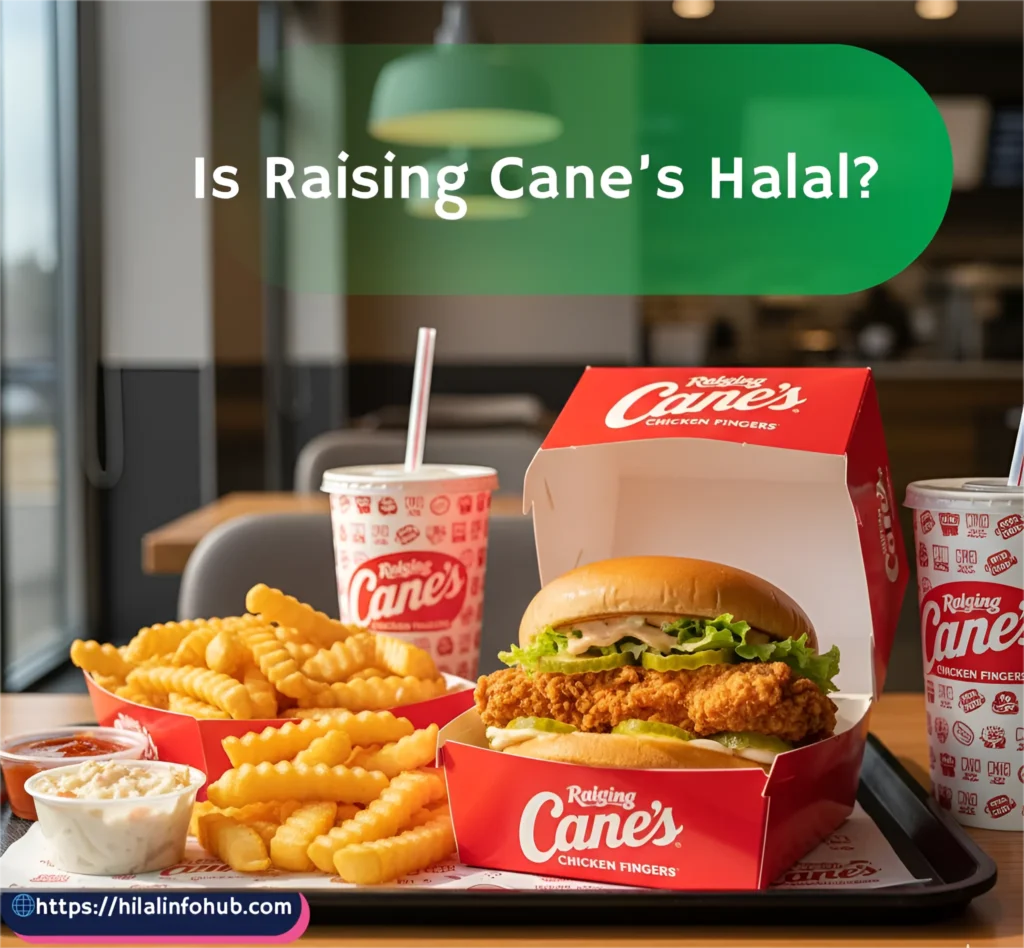
The moment you step inside any Raising Cane’s, the scent of freshly battered chicken fingers, crinkle-cut fries and that renowned Cane’s Sauce greets you right away. The reason for its popularity lies in the ease of its menu. But for Muslim consumers who adhere to Islamic dietary restrictions, a very important question surfaces: Is Raising Cane’s halal?
In halal dining, it’s not sufficient that a meal sounds okay. It also counts how the meat is procured, how it was killed, if other food ingredients or cooking methods compromise halal integrity, and if there is trusted certification. With the shift in the fast-food scene and consumers who are becoming more aware of halal, the case of Raising Cane’s and halal needs a close examination.
In this post we’ll be looking at: what “halal” actually means in practice, what Raising Cane’s official stance is, what serious investigations can tell us about its chicken and other food, how to read the situation if you’re in the USA (or other places), and what practical actions you can take if you still want to eat there but don’t compromise on your halal standards.
What Does “Halal” Mean?
The word halal in Arabic directly translates to “lawful” or “permissible.” In foods, to Muslims it entails a number of essential criteria:
- Acceptable species – The animal can be consumed (e.g., chicken is acceptable, pork is not).
- Correct slaughter (zabiha) – The animal has to be alive when slaughtered, a recitation (in the name of Allah) needs to be said, blood needs to be drained, and other things fulfilled.
- No prohibited ingredients – Like pork or pork derivatives, alcohol or intoxicating substances, or other clearly proscribed ingredients.
- No cross-contamination – Even when the meat is halal, when cooked with or cooked in the same utensils as non-halal meat, or where prohibited substances are added, the halal character is lost.
- Clear supply chain & certification – Most Muslims seek halal certification from known Islamic organizations or at least transparent supplier papers.
When evaluating a restaurant such as Raising Cane’s, all these aspects count. It is not sufficient that the chicken is chicken; you need to ask: was the chicken slaughtered in keeping with Islamic teachings? Is the supply chain halal certified? Are fryers commingled with non-halal products?
Raising Cane’s: What We Know
Company and Menu Overview
Raising Cane’s is a United States fast-food company established in 1996 in Baton Rouge, Louisiana, by Todd Graves. The company specializes in chicken fingers (tenderloins), crinkle-cut fries, Texas toast, coleslaw and the brand Cane’s Sauce. The company has expanded aggressively to hundreds of outlets. Their advertising is focused on “100% white breast meat chicken” that is “fresh, never ever frozen” in most outlets.
Official Halal/Cosher Status
As per various research and official replies, Raising Cane’s itself declares that its chain of restaurants and chicken-finger meals are not certified halal or kosher. To illustrate: “Our Restaurants and craveable Chicken Finger meals are not certified Halal or Kosher.” That is, the company does not make. a claim that their chicken is halal-slaughtered or that their whole menu is halal-certified.
Investigative Findings
Various halal-food manuals have examined the scenario:
- One guide states: “Raising Cane’s is not halal and, as such, not appropriate for Muslims to consume.”
- Another states that although Raising Cane’s has international outlets (including Middle East) where halal sourcing is applicable, in the USA there is no officially recognized halal-certified chicken or standard assurance.
- They also point out major concerns: absence of halal certification, ambiguity regarding slaughter method, common fryers/cooking process and more than one chicken supplier source.
For instance, in a very specific breakdown, it was reported that: “The chicken consumed at Raising Cane’s is not sourced from a halal-certified supplier … The fries are fried in the same oil as non-halal chicken, and therefore are not halal according to many scholars.”
Why Most Muslim Diners Find It Not Halal
From the perspective of halal-food law, a number of red flags arise in evaluating Raising Cane’s:
- No halal certification – Without evidence from an accepted certifier indicating that chickens were slaughtered in the name of Allah and in accordance with zabiha, the minimum requirement is not fulfilled.
- Unclear slaughter process – Public declarations of the company reveal that they source from USDA-inspected facilities and adhere to humane slaughter practices, but they are not the same as Islamic zabiha.
- Common cooking equipment/fryer – Even veggie items (fries, Texas toast) are fried in the same atmosphere as non-halal chicken. That causes cross-contamination issues.
- Multiple sources of suppliers – The firm indicates it sources from “multiple sources around the country” and thus consistency of halal sourcing is not a guarantee.
- Variation within regions – Although some foreign branches may provide halal chicken, this does not extend equally in the U.S. One cannot then assume a location in the U.S. is halal.
Considering these points, most halal-conscious Muslims conclude that until proper certification is made available, Raising Cane’s must be considered not halal under their dietary compliance.
Are There Exceptions or “Halal-Friendly” Options?
Although the general consensus is “not halal,” there are complexities to consider:
- Some users note that in Muslim-dominant nations (such as Gulf nations) Raising Cane’s locations might utilize halal-approved vendors in order to meet local requirements.
- For non-meat foods (drinks, coleslaw, Texas toast, french fries) ingredients themselves may be halal-compatible (no pork, no alcohol), but cross-contamination (same oil/fryer) is always a problem.
- If a specific site can assure halal chicken supplier and different cooking equipment, then locally it could be all right—but such assurance is unusual in the U.S. setting.
Thus, some Muslim diners may choose to eat only the sides (with the understanding of risk), while avoiding the chicken altogether. Others may choose to avoid the restaurant entirely in favor of fully certified halal alternatives.
What Should Muslim Diners Do? Practical Guidance
Here is a checklist you can use when deciding about visiting a Raising Cane’s (or similar chain) from a halal perspective:
- Call the restaurant: Enquire if they utilize halal-certified chicken, and if they have a halal certificate from an accepted Islamic authority.
- Inquire about suppliers: Are the chicken suppliers halal-slaughtered? Are there records?
- Inquire about cooking procedures: Are fryers, grills or other utensils used in conjunction with non-halal meat?
- Inspect the menu ingredients: Are there any suspicious items (e.g., sauces containing alcohol-based vinegar, enzymes of non-halal origin)?
- In doubt, play it safe: If the restaurant is not able to assure halal compliance, most scholars believe one should avoid eating the meat.
- Opt for sides only: If the meat is not certified, one may opt for vegetarian options (but still be aware of cross-contact) or drinks instead.
- Seek out certified halal alternatives: In most major cities there are specific halal-certified chicken restaurants or chains that serve halal-observant consumers.
Regional Considerations: USA vs. Middle East/International
It should be noted that a restaurant chain’s halal status can vary country to country or region to region:
- United States (and most likely Canada): Raising Cane’s explicitly declares it is not halal-certified. The default assumption: chicken fingers and related meals are not halal.
- Middle East / Muslim nations: Certain Raising Cane’s locations in nations like Saudi Arabia, UAE, Kuwait, Bahrain might be under halal supply chains and local halal certification, since local law necessitates it. So there, the menu can actually be halal (but do check locally anyway).
- For a Pakistani Muslim consumer (or any other Muslim consumer) contemplating Raising Cane’s, the best course of action is to assume not halal unless you have confirmed, reliable information from the particular site.
Why This Matters: Market & Consumer Trends
The market for halal foods is expanding quickly around the world, and numerous chains of fast foods are facing mounting pressure to offer halal-certified alternatives. According to one guide, the worldwide market for halal foods has been estimated to be trillions.
For chains like Raising Cane’s, offering halal options (and certified supply chains) could open up new markets and better serve Muslim consumers. Until then, the lack of formal halal certification remains a barrier for many Muslims who wish to dine confidently.
Conclusion
For Muslim consumers, dining should never be about sacrificing religious dietary standards. Regarding Raising Cane’s, the existing evidence suggests that the majority of locations within the U.S. are not completely halal-compliant unless they can prove proper halal certification and showcase committed handling procedures. Although the chicken is probably tasty and desirable, it is not always halal. If reassurance is necessary, then going to restaurants or food places that have clearly posted halal certification or adhere to confirmed halal practices is the safest method. By showing respect for transparency and keeping halal standards in mind, Muslim patrons can eat without giving up their faith.
For more like this visit : Hilalinfohub
