
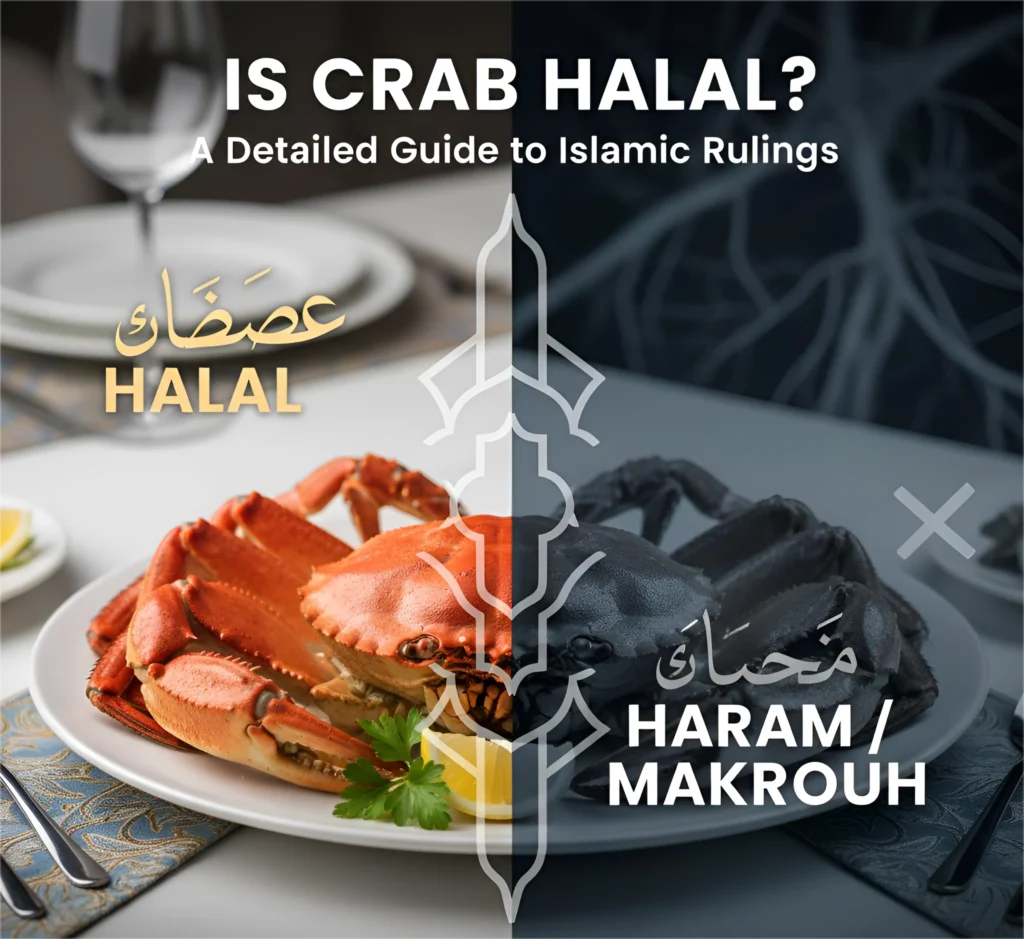
Is Crab Halal or Haram? A Detailed Islamic Rulings Guide
From steamed king crab legs and creamy bisques to savory crab cakes and hot curries, crab is a revered gourmet in cuisines from across the globe. For Muslims, however, indulging in this favorite crustacean isn’t simply a question of taste—it’s a question of religious acceptability, or fiqh. The inquiry becomes, “Is crab halal?” one of the most frequent questions of seafood in Islam, and the response is not merely yes or no.
The halal-ness of crab depends solely on which school of thought (madhhab) you adhere to. In Islam, there are a number of large schools of jurisprudence, and each has its own approach to understanding the direct sources: the Qur’an and the Sunnah (the Prophetic traditions).
This article will offer a thorough and respectful overview of the various arguments on whether crab is permissible, covering the evidence utilized by each school.
The Foundation: What Makes Seafood Halal?
Before diving into the specific case of crab, it’s essential to understand the general principles Islam lays out for food from the sea. Unlike land animals, which have strict rules for slaughter (dhabiha), seafood is treated with a broader permissibility.
This is primarily based on two key pieces of scriptural evidence:
- The Qur’an (Surah Al-Ma’idah, 5:96):
“Lawful to you is game from the sea and its food as provision for you and the travelers.”
- The Hadith (Prophetic Tradition):
When the Prophet Muhammad (peace be upon him) was questioned regarding the sea, he replied:
“Its water cleanses, and its dead (animals) are permissible (halal).” (Reported by Al-Tirmidhi, Abu Dawood, and others – Sahih)
These sources set a strong general principle: everything which is from the sea is okay to eat. The whole basis of scholarly difference (ikhtilaf) is one issue: What is “game from the sea” and “its dead” included?
Does it mean literally everything that lives in water, or does it just apply to what is traditionally referred to as “fish” (samak)? The response to this question makes the decision regarding crab.
The Majority Sunni View: Crab is Halal
To most Muslims, especially to those who subscribe to the Shafi’i, Maliki, and Hanbali schools of thought, the response is an unhesitant and emphatic yes, crab is halal.
These three great Sunni schools interpret the Qur’anic verse and the Hadith in their broadest and most literal sense.
The Reasoning (Shafi’i, Maliki, Hanbali):
- Wide Interpretation: Their principle of law is that “everything from the sea is halal unless specifically forbidden.” The default condition of sea creatures is that they are permissible.
- “Game of the Sea”: They contend that “game from the sea” (sayd al-bahr) is comprehensive in its meaning. A crab is an animal that spends its life in the sea; hence, it is “game from the sea” and is included under the express permission in the Qur’an.
- No “Fish” Restriction: There is no restriction of permission to only “fish” in these schools. They say that if Allah and His Messenger wanted to permit only fish, they would have stated the word “fish” (samak) rather than the comprehensive expression “game from the sea.”
- Analogy to Shrimp: Many scholars point to shrimp, which is almost universally accepted as halal, yet is not technically a “fish.” Like shrimp, crabs are crustaceans that live in the water. The logic that permits one generally permits the other.
- “Its Dead are Lawful”: The Hadith “its dead are lawful” is significant. It indicates that sea animals do not need the Islamic ritual slaughter that is necessary for land animals. Sea animals are halal even if they are found dead (died naturally, not poisoned or diseased). This rule basically applies to crabs in the same way that it applies to fish.
To adherents of these madhhabs, however—which encompass a large majority of the Muslim world, by the way, including in parts of Southeast Asia (Malaysia, Indonesia), the Middle East, and Africa—crab is an acceptable and popular component of the halal diet.
The Hanafi View: Why Crab is Haram or Makruh
The Hanafi school of thought’s view, which dominates South Asia (Pakistan, India, Bangladesh), Turkey, and Central Asia, is significantly different.
For the majority of Hanafi scholars, crab is either Haram (prohibited) or Makruh Tahrimi (prohibitively disliked, almost haram).
This decision tends to catch Muslims of other cultures by surprise but follows a specific legal approach.
The Reasoning (Hanafi):
- The “Fish” ($Samak$) Limitation: Hanafi jurisprudence views the Qur’anic phrase “game from the sea” and the Hadith “its dead are lawful” in a different manner. They believe that these general allowances are delineated by other traditions and linguistic study to mean only that which is rightly described as “fish” (samak).
- Non-Fish Classification: A crab, according to their classification, is not considered a fish. It is usually compared to a hasharat (vermin, insect, or creature of the earth) or sea animal that is similar to land animals that are haram (such as spiders or scorpions).
- The Amphibious Argument: One central component of the Hanafi argument is that crabs tend to be amphibious—they can exist and move on land for long periods as much as in water. Creatures that are not entirely aquatic (i.e., they cannot survive only in water) do not come under the “game of the sea” dispensation. They are evaluated according to the land animals’ rules, and as they are not an “animal of grazing” (such as cattle) and are “abominable” (khaba’ith), they are forbidden.
- Particular Hadith: Hanafi authorities rely on the Prophet’s instruction to “consume that which is good (tayyib) and legal” and to abstain from that which is “vile” or “abominable.” According to their understanding, animals which are not “fish” are included in this latter category.
So, for Hanafi followers, crab is normally avoided. It also applies to the other sea animals that aren’t “fish,” i.e., lobster, squid, octopus, and shellfish (clams, mussels, oysters).
Note that even in the Hanafi school, there can be nuances. Some scientists might pronounce Makruh (disliked) instead of categorically Haram, but the practical effect is still a strong advice to avoid.
The Shia Ja’fari Perspective: The “Scales” Criterion
The Ja’fari school of jurisprudence, adhered to by Shia Muslims, differs and is very particular in identifying what sea animals are halal.
In Ja’fari school, crab is held to be Haram (prohibited).
The Reasoning (Ja’fari):
- The Rule of Scales: The Ja’fari jurisprudence follows narrations from the Ahlul Bayt (the Prophet’s family and Imams). In their traditions, the only sea creatures that are halal are:
- Scaled fish.
- Shrimp/Prawns (which are specifically exempted by name in their narrations).
- Explicit Prohibition: All sea animals which do not possess scales are, per se, haram.
- Crab Doesn’t Have Scales: A crab is a crustacean animal with a hard, outer casing (shell) but without scales (fils).
- Application: Since crabs do not pass the “scales” test, they are definitively haram under Ja’fari fiqh. This judgment also renders other common seafood such as lobster, squid, octopus, clams, oysters, and catfish (which is not scaled) haram.
This is a very cut-and-dry rule with no wiggle room. For a Shia Muslim, the question “is crab halal?” can be answered emphatically with “no.”
Frequently Asked Questions (FAQ) regarding Crab and Halal Seafood
The conversation about crab naturally turns to more pointed, practical questions.
Q: What about imitation crab? Is that halal?
This is a great question. Imitation crab (also surimi or crabstick) is usually halal, but you MUST look at the ingredients.
- What it is: Imitation crab is not actually crab. It is processed food consisting of white fish (most often pollock), which is pounded into a paste. This fish paste (surimi) is halal because pollock is a scaly fish and, therefore, acceptable to all schools of thought.
- The Catch (Ingredients): Danger lurks in the other ingredients used to give it flavor, color, and preserve it. You need to look at the label for:
- Mirin (Rice Wine): Mirin, a Japanese rice wine, is one of the most used ingredients in surimi manufacturing. Anything with alcohol is haram.
- Carmine: Imitation crab contains carmine (or cochineal extract) as its red dye. It is an insect-crushing dye, which is haram according to most scholars.
- Other Additives: Look for other non-halal flavor enhancers, enzymes, or binders.
If the imitation crab is halal certified, or if the ingredients don’t contain alcohol, carmine, and other forbidden materials, then one may eat it, even Hanafis and Ja’faris.
Q: Does the type of crab matter (King Crab, Snow Crab, Blue Crab, etc.)?
No. The rulings outlined apply to the category of “crab.” Whether you are a King Crab, a Dungeness Crab, or a tiny shore crab, the principle is the same. If you belong to a madhhab which allows crab, all non-toxic types are halal. If you belong to one which prohibits it, all types are prohibited.
Q: What about other controversial seafood like lobster, squid, and oysters?
The same logic applies:
- Shafi’i, Maliki, Hanbali: Halal. All are “game from the sea.”
- Hanafi: Haram/Makruh. They are not “fish.”
- Ja’fari: Haram. They are not scaled.
Q: What do I do if I am a guest and offered crab?
This is a prevalent social dilemma. The rule of thumb is to stick to your own madhhab and belief.
- If you belong to a school that holds it to be haram (Hanafi, Ja’fari), politely refuse to consume it. You don’t have to discuss the finer points of fiqh with your host; a “Sorry, I don’t eat crab” or “I have dietary restrictions” should suffice.
- If you are from a school that holds it to be halal, then you can consume it.
- It is rude to argue with the host or fellow guests about it. Islamic law is extensive, and holding in respect differences of opinion (ikhtilaf) is a part of tradition.
Q: Does the mode of killing the crab matter?
No. As the Hadith “its dead are lawful” states, sea animals do not need the dhabiha (ritual slaughter) land animals need. They are halal no matter how they die (e.g., through netting, boiling, or death in the sea), provided that they are not sick or poisoned.
Conclusion: A Matter of Following Your School
So, is crab halal? As we have learned, there is no one consensus that is agreed upon by all Muslims. The reply is a simple “it depends.”
- For adherents of the Shafi’i, Maliki, and Hanbali schools, crab is Halal and an acceptable delicacy to indulge in.
- For adherents of the Hanafi school, crab is Haram or Makruh (prohibitively disliked) and not to be indulged in.
- For believers of the Ja’fari (Shia) school of thought, crab is Haram as it is a sea animal which does not have scales.
This variety of opinion is not a weakness of Islamic law, but rather an accepted and honored aspect of its rich jurisprudence (fiqh). The various schools of thought all apply the same basic sources (Qur’an and Sunnah) but employ distinct valid methodologies for their interpretation.The most important takeaway is for a Muslim to understand the reasoning behind their own school of thought and to follow it with confidence. If you are unsure which madhhab you follow, it is best to consult a trusted local scholar or imam who can provide guidance based on your community and background.
For more like this visit : Hilalinfohub
