
Introduction
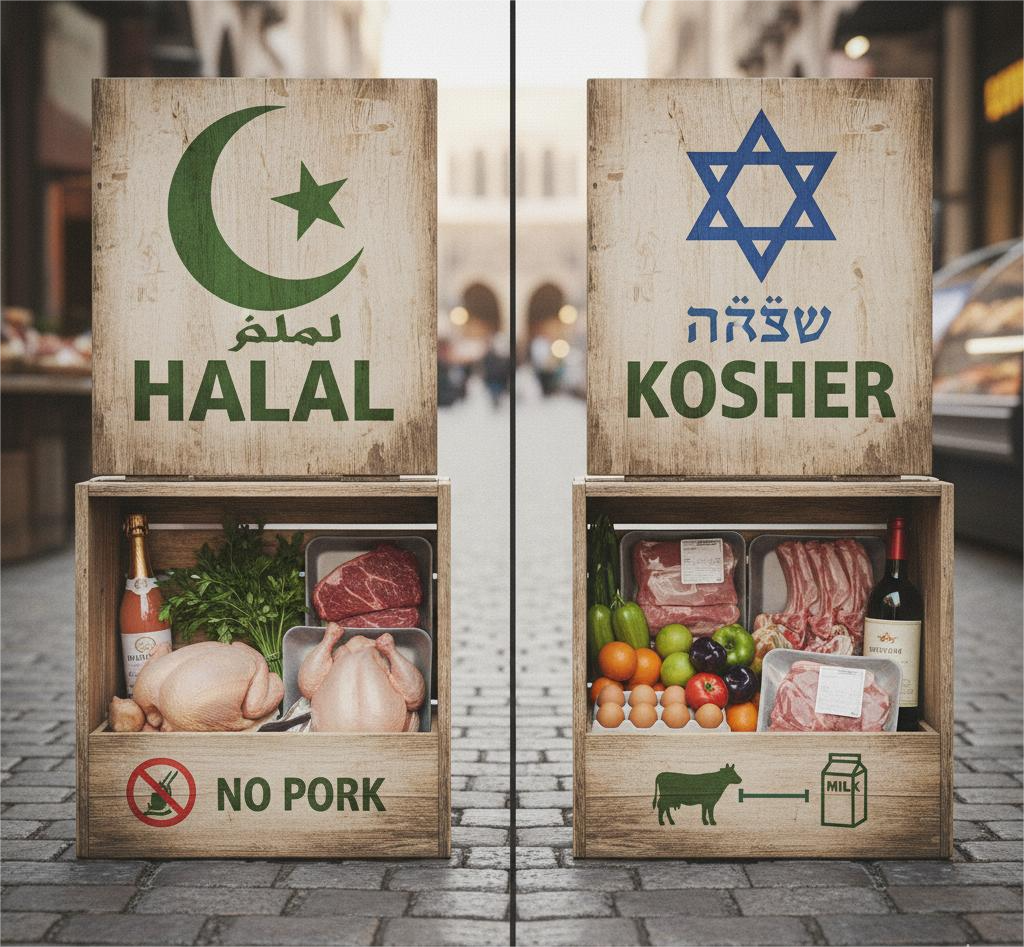
Food is about more than just sustenance — it’s a reflection of religion, culture, and identity. For Jews and Muslims, religious dietary systems direct what can and cannot be consumed and how food must be prepared. The two most popular religious dietary systems are Halal, practiced by Muslims, and Kosher, practiced by Jews.
Though there are some similarities between the two traditions — including humane animal slaughter, the ban on blood, and abstaining from pork — they differ. This article delves into the difference between Kosher and Halal, highlighting their history, regulations, and religious significance.
Halal and Kosher: Understanding the Meaning
What is Halal?
“Halal” (Arabic: حلال) is permissible or lawful under Islamic law, also referred to as Sharia. Haram is its opposite, meaning forbidden.Halal covers all walks of life — and not only food. But in terms of food, it means food and beverages that are permissible for Muslims to eat, based on rules outlined in the Qur’an and Hadith (words of Prophet Muhammad, peace be upon him).
What Does Kosher Mean?
“Kosher” is derived from the Hebrew term kashér, which means fit or proper in accordance with Kashrut, the collection of Jewish dietary regulations contained mainly in the Torah.Similarly with Halal, Kosher food has to comply with rigid requirements — from the animals that can be consumed to the preparation, cooking, and even serving of the food.
Halal and Kosher Food Laws: Similarities
Before exploring the differences, it’s helpful to understand what Halal and Kosher have in common.
- Religious Foundations:
Both dietary systems are rooted in sacred texts — the Qur’an for Muslims and the Torah for Jews. They serve as expressions of obedience and devotion to God. - Prohibition of Pork:
Both Islam and Judaism strictly prohibit the consumption of pork and pork-derived products. - Humane Slaughter Practices:
Both demand animals to be killed with a quick cut across the throat so that blood drains out fully, reducing pain. - Prohibition of Blood:
Both religions prohibit the drinking of blood in any way, stressing cleanliness and purity. - Blessings and Intentions:
In both of them, God’s name has to be called at the time of slaughter, appreciating the sanctity of life and that of taking it for consumption.
The Key Differences Between Halal and Kosher
While sharing these similarities, Halal and Kosher are different in many significant aspects — ranging from the religious ceremonies involved at the time of slaughter to how dairy and meat are handled.
1. The Slaughtering Process
- Halal Slaughter (Dhabihah):
The killing has to be done by a sane adult Muslim, who says Bismillah, Allahu Akbar (“In the name of Allah, God is the Greatest”) prior to every animal’s slaughter.
The knife should be sharp, and the throat, windpipe, and main blood vessels of the animal have to be cut quickly so that the blood drains completely. - Kosher Slaughter (Shechita):
The slaughter should be performed by a Shochet, an expert, trained, and certified Jewish person.
The blessing is recited once at the beginning of the session, not for every animal.
Following slaughter, the animal’s internal organs are checked (a procedure known as bedikah) to find out whether it is healthy or defective — a procedure not necessary in Halal law.
Key Difference:
In Halal, the invocation is required prior to each slaughter, whereas in Kosher, a single blessing can suffice for a whole session. Moreover, the inspection process after slaughter in Kosher is much more extensive.
2. Permissible Animals
- Halal:
All plant-eating animals which are not carnivorous (e.g., cows, sheep, goats, camels, poultry) are widely acceptable.
Fish is Halal if it is scale-bearing, and Islamic scholars disagree regarding seafood such as shellfish and squid. - Kosher:
Only animals which both chew the cud and bear split hooves are permitted — e.g., cows, sheep, and goats.
Fowl such as chicken, turkey, and duck are Kosher, but rabbit, camel, and most seafood (with the exception of fish with fins and scales) are not.
Key Difference:
Some Halal-permissible animals are not Kosher (e.g., camel), and vice versa.
3. Treatment of Meat and Dairy
This is one of the largest differences between Halal and Kosher.
- Halal:
There is no ban on combining meat and dairy. Muslims are allowed to eat both in the same meal as long as each is Halal. - Kosher:
Mixing meat and dairy is strictly forbidden under Jewish law. Separate utensils, dishes, and even cooking equipment must be used for meat and dairy.
After eating meat, observant Jews must wait several hours before consuming dairy.
Key Difference:
Kosher laws demand complete separation of meat and dairy; Halal has no such restriction.
4. Alcohol and Intoxicants
- Halal:
Alcohol is strictly prohibited in all forms — including foods cooked or processed using alcohol, or ingredients containing it. - Kosher:
Alcohol itself is not banned. But to be Kosher-certified, it has to be produced under Jewish supervision and from Kosher ingredients.
Thus, Kosher wine is possible, while Halal wine is not.
Key Difference:
Kosher permits alcohol under specific conditions; Halal prohibits it entirely.
5. Certification and Supervision
- Halal Certification:
The Halal Food Authority (HFA) or JAKIM (in Malaysia) certifies products that are in accordance with Islamic requirements. - Kosher Certification:
Other Jewish associations, such as the Orthodox Union (OU) or Star-K, oversee Kosher adherence.
Both employ certain symbols on packaging — e.g., a crescent symbol (Halal) or the “OU” mark (Kosher).
Key Difference:
Supervision in Kosher can entail the presence of a Rabbi, whereas Halal certification can sometimes depend on inspection and documentation without necessarily involving on-site supervision.
6. Religious Intent and Blessings
In Halal, mentioning Allah’s name is imperative in every slaughter. In Kosher, the slaughterer utters a blessing only once and goes on so long as he does not take a break or becomes distracted.If the blessing is left out in Halal slaughter, the meat is not Halal. But in Kosher practice, not uttering the blessing does not necessarily render the meat non-Kosher.
Key Difference:
The function and frequency of religious invocation are different in Halal and Kosher rituals.
Can Muslims Eat Kosher Food?
This is an easy question — and the answer is up to interpretation.
Most Islamic experts believe that Kosher meat can be eaten by Muslims if it’s according to the Halal standards — most notably if the name of Allah is invoked and the animal is slaughtered in proper fashion.But current Kosher procedures usually leave out the Bismillah invocation, and Kosher plants might touch alcohol or non-Halal products. Thus, not everything Kosher is inherently Halal.Muslims are advised to check for certification and know how the food was prepared before it’s eaten.
Can Jews Eat Halal Food?
For religious Jews, Halal food is not Kosher, as it doesn’t observe all the intricate regulations of Kashrut — including the keeping of milk and meat separate, strict animal inspections, and only using Kosher-certified ingredients and equipment.
Therefore, although Muslim food may at times be Kosher, Halal food is rarely Kosher.
Religious and Ethical Philosophy Behind the Laws
Apart from rules and regulations, both are based on profound ethical and spiritual philosophies.
Halal Philosophy
Islamic dietary principles instill cleanliness, sympathy, and thankfulness. Slaughtering with Bismillah serves as a reminder that life is holy and humans are accountable for how they live it.Halal even goes beyond food safety, cleanliness, and fair trade — focusing on the moral dimension of what Muslims eat.
Kosher Philosophy
In Judaism, Kosher eating is a religious act — a daily expression of God-consciousness and spiritual discipline.
The dietary laws remind Jews to live with awareness, purity, and deference to God’s commands.Both Halal and Kosher promote mindful eating — in which food becomes a vehicle of faith and introspection.
Contemporary Challenges and Trade Practices
In the modern food market, adhering to religious requirements has become more complicated.
- Cross-contamination: The same production lines can process both non-Halal and non-Kosher products.
- Label Misuse: Certain producers use Halal or Kosher labeling as a marketing tool without authentic certification.
- Global Trade: Export and import laws are different, with third-party audits and labeling transparency needed.
Both Muslim and Jewish consumers are now demanding transparent labeling and authentic certifications to confirm authenticity.
Conclusion: Halal vs Kosher — Two Paths, One Purpose
The halal and kosher difference is one of details — the very particular rules, rituals, and religious authorities who created them. And yet, beneath their surface, both share a deep reverence for life, cleanliness, and the humane treatment of animals.The Halal and Kosher diets bring the faithful back to the realization that food is not only physical but spiritual — a manifestation of obedience, thankfulness, and awareness.For consumers today, understanding these differences fosters respect across faiths and cultures — and encourages everyone to make more conscious, ethical food choices.
For more like this visit: Hilalinfohub
