Are M&M’s Halal? — A Comprehensive Guide for Muslim Consumers
When it comes to everyday treats, many of us wonder whether they fit within our dietary guidelines. A common question: “Are M&M’s halal? ” The short answer: it depends — on the country, the specific variety, the ingredients, and whether there is halal certification.
In this article, we will dissect what “halal” is, look at the ingredients and production of M&M’s, consider the status in various countries (such as the UK, U.S., Pakistan, etc.), and provide advice on how you can make an informed choice.
What Is “Halal” in Food?
The halal (Arabic: حلال) term literally translates to “permissible” or “lawful.” When applied to food, it means:
- The product should not include haram ingredients — i.e., pork or pork-by-products, non-slaughtered animals in the religious Islamic manner, alcohol consumed as an ingredient (or intoxicants).
- Manufacturing, handling, storage and processing shall be free from haram contamination.
- Ideally, the product is endorsed by a recognized halal certification body which inspects ingredients and process.
These requirements are not consistent globally — different nations and certification agencies can have slightly differing requirements.From a consumer point of view: even if a product does not say “halal” explicitly, the question is whether there has been any non-halal ingredient or contamination involved (for you individually). In the context of our discussion of M&M’s, this comes sharply into focus.
The Ingredients & Production of M&M’s
What are M&M’s?
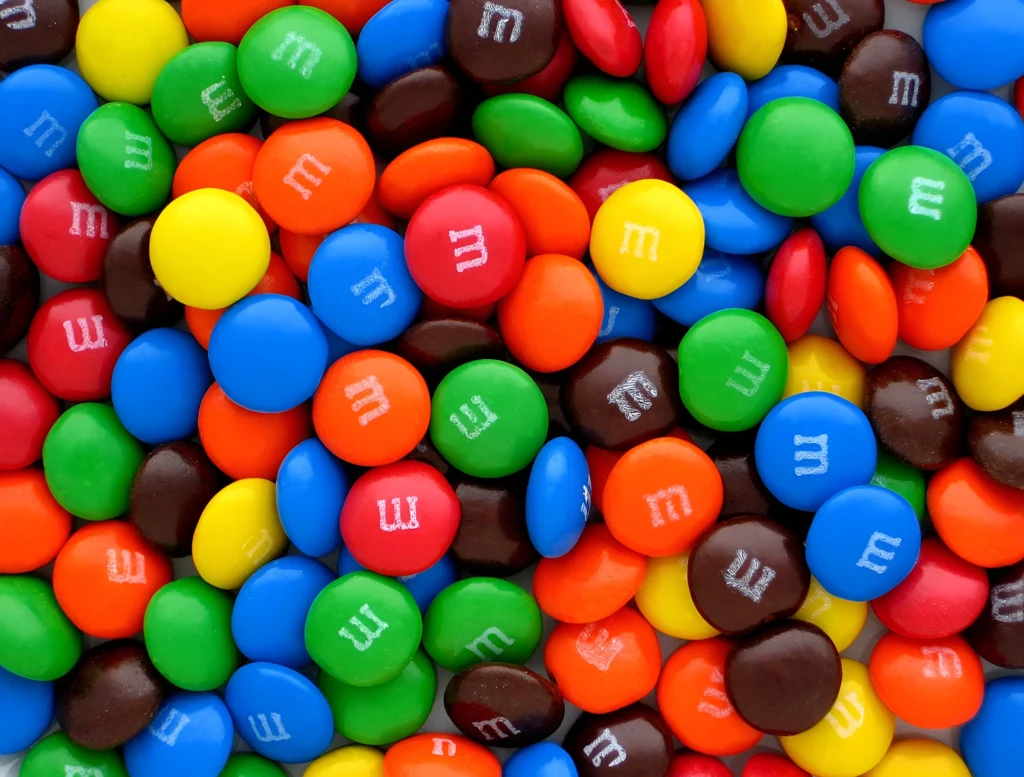
M&M’s are small pieces of colourful, candy-coated chocolate made by Mars Wrigley (a subsidiary company of Mars Inc.). They are manufactured in numerous countries, each possibly using slightly different compositions.
Typical Ingredients
In one of the reviews of M&M’s, the following ingredients are listed: “milk chocolate (sugar, chocolate, skim milk, cocoa butter, cocoa mass, lactose, milkfat, soy lecithin, salt, artificial flavours), sugar, corn starch, less than 1 % of corn syrup, dextrin, colours (including Red 40 Lake, Yellow 5, Yellow 6, etc), glazing agents (gum acacia, carnauba wax), etc.”
Key Areas of Concern for Halal Assessment
When evaluating halal status, the problematic areas frequently comprise:
- Colourings & glazing agents: Certain red colourings (e.g., carmine/E120 of insect origin) or coatings such as beeswax can be derived from non-halal origins.
- Emulsifiers/flavourings/vanilla extract: Some might be animal derived or processed with alcohol.
- Cross-contamination during production: Equipment shared with non-halal ingredients or animal-derived additives.
- Certification or none: Even if the ingredients look fine, in the absence of a certification or warranty from the manufacturer, some consumers are still careful.
Global Variation: Are M&M’s Halal Worldwide?
In the United Kingdom (UK)
In the UK, it is plain and simple: the official Twitter handle of M&M’s UK replied (in February 2019) to a consumer question saying:M&M’s do not fit into a Halal diet. We add additives that are derived from animal products when we are producing M&M’s and residuals of these can be detected in the sweets. While you can be sure that all products sold on regular supermarket racks … in the UAE are halal, … in the UK they were found to be not suitable for a halal diet.” Therefore, for UK-made (or UK-market) M&M’s: not halal certified, and by the company’s statement, not suitable for a halal diet.
In the United States (US)
The US version could be different. US M&M’s are not reported to contain ingredients such as carmine, or beeswax coatings that are animal-based, and therefore might be closer to halal-friendly ingredient-wise. But the significant caveat: they are not necessarily halal-certified in the US. One site outlined:
“Across much of the Middle East and Southeast Asia, Mars has received halal certification for certain varieties. But in the US and UK, M&M’s may not have official halal certification.” So, even though the ingredients may be more palatable in the US version, without being certified there is still doubt for strict halal watchers.
In Muslim-majority countries / Middle East / Southeast Asia
In some countries, such as portions of Southeast Asia and the Middle East, M&M’s (or specific flavors) are sold as halal-certified. For instance, one article explains:”Where we have Halal-certified products, this is indicated on the product packaging.”
In the UAE, for instance, M&M’s are typically halal certified. For buyers in Pakistan, Malaysia, Indonesia, etc., it’s probable that the locally packaged product is halal certified (at least labeled as such) although one must verify locally. Some bloggers though claim that even in Pakistan, some M&M’s are not halal, cautioning.
So, Are M&M’s Halal in Pakistan? (and by extension South Asia)
If you are from Pakistan (or reside in Karachi, as you do), this question is highly pertinent. Here are some important take-aways:
- There is no general statement from Mars Inc. that “all M&M’s worldwide are halal”. Certification is region-wise.
- If you purchase M&M’s from a local Pakistani store, you should find a halal certification mark (from a local recognised body). If there’s a halal logo on the packaging, then it’s safer.
- If the packaging does not have such a mark, then one should exercise caution — either check the ingredients carefully or contact the importer/manufacturer.
- Some websites assert that in Pakistan, M&M’s are not necessarily halal because the factory or ingredients can trace back to non-halal sources.
- Since it is established UK variety is not halal, and since many international supply chains use shared ingredients or lines, you might think that without certification it is still in doubt.
So: For South Asia / Pakistan, the most cautious course of action is to purchase only M&M’s that are displaying halal certification (or purchase a region-specific one bearing the label halal). In the absence of certification, be cautious.
Why the Difference? Why Are Some M&M’s Halal & Some Not?
- Variation in Regional Ingredients – The same product might employ slightly different glazing agents, colourants or additives in various countries. For instance, in the UK formulation some insect-based red colourings (carmine) were employed.
- Various Manufacturing Plants – Some might have special halal lines, or procure halal-certified ingredients; others might have mixed lines or common machinery.
- Certification Requirements – Halal certification demands auditing of sourcing of ingredients, processing, cleaning, packaging etc. Certification of only some markets may be selected by a manufacturer. As one article states: “In some countries… the company has obtained halal certification for certain varieties. This certification assures that the products are in strict conformation with halal requirements and safe for Muslim consumption.”
- Regulatory & Consumer Pressure – For those nations with a high Muslim population, there is a greater consumer drive and regulatory backdrop for halal certification, so the firm could do so too.
- Additives & Trace Ingredients – Many consumers are concerned about “additives from animal products” or “traces” of non-halal ingredients. The UK account tweet, for example, said: “We use additives that come from animal products … traces of these can be found in the sweets.”
Main Varieties of M&M’s & Their Halal Issues
- Plain Milk Chocolate M&M’s – They will generally contain fewer added ingredients, so from a halal-ingredient viewpoint, they could be safer (assuming no non-halal additives).
- Peanut, Hazelnut, Crispy, Caramel, Pretzel versions – Other ingredients like nuts, cereal, caramel, or coatings will add more complicated additives (glazing agents, colorants, enzyme treatments) which will have sources that are non‐halal.
- Seasonal or Limited Edition Flavours – These may use special colourings, flavourings or coatings and may lack full transparency on ingredient sourcing.
- Region-specific versions – For instance, UK versions may differ from US versions in colourants and coatings (beeswax vs carnauba wax, presence of E120).
Therefore, when checking a specific variety, always review the ingredient list and packaging certification, rather than assuming all M&M’s are equivalent.
What the Company Says
“We sell quality products all over the world & seek to meet our consumers’ needs in each market where we operate. In some countries, this includes certifying our products as Halal. Where we have Halal-certified products, this is indicated on the product packaging.” ([thetwinpost.wordpress.com][9])Still, the brand does not make a blanket statement saying all products are halal. Take, for instance, the UK account’s tweet:
“M&M’s are not suitable for a Halal diet. We use additives that come from animal products when we’re making M&M’s and traces of these can be found in the sweets.” So, then, it is left to packaging and certification in regions to note halal status.
So, What Should You Do as a Muslim Consumer?
The following are steps to follow in terms of whether the M&M’s you purchase are halal (particularly in Pakistan / South Asia):
Check the Packaging
- Look for a halal certification logo (issued by an accepted body in your country).
- See whether the variety and region are designated as halal.
- If the packaging reads “halal certified”, record the certifier and expiry.
Check the Ingredients List
- Steer clear of known haram ingredients: pork, non-halal gelatine, non-halal rennet, alcohol as an ingredient.
- Verify the colourants: If the ingredient list contains E120 (carmine), or “cochineal extract”, these are insect-based and could be regarded as haram by most scholars.
- Verify the coating agents: beeswax, shellac, etc could be of animal/insect origin.
Verify Production & Origin
- Look for the country of origin (usually marked on the pack). If it’s one where Mars makes halal-certified ones (such as some Middle East nations), the likelihood is greater.
- If from a non-Muslim world area and not halal certified, be careful.
Ask the Manufacturer / Importer
- In case of doubt, call Mars Inc. or the local distributor to inquire regarding halal status of that particular pack or flavor.
- Be aware that even if the ingredient list is fine, cross-contamination or common equipment is possible.
- Make a Personal Decision Based on Your School of Thought
- Some scholars may consider a product permissible if no explicitly haram ingredients exist, even without certification.
- Others may insist on halal certification to ensure compliance with process and contamination factors.
- So your decision may depend on your personal level of caution and the advice of your local scholar.
Conclusion
The question “Are M&M’s halal?” does not have one global answer.In certain countries and for certain types, yes — they are halal-certified and labeled as such.In some (particularly the UK, and perhaps the U.S. and other non-Muslim-majority markets), they are not halal certified, and the company themselves have claimed they are not suitable for a halal diet in certain markets.
For Pakistani consumers (and Karachi consumers in particular), the safe path: only eat those packets of M&M’s which clearly indicate halal certification relevant to your nation. In case of non-certified packaging, check ingredients carefully, inspect origin-country, and evaluate if you feel okay with possible cross contamination or unclear additive origins.If in doubt, contact the manufacturer/distributor or opt for a substitute product that contains good halal certification.Lastly: indulge in your snacks, but practice caution, reading packaging labels and certification to ensure it squares with your dietary values.
For more like this visit : Hilalinfohub
