
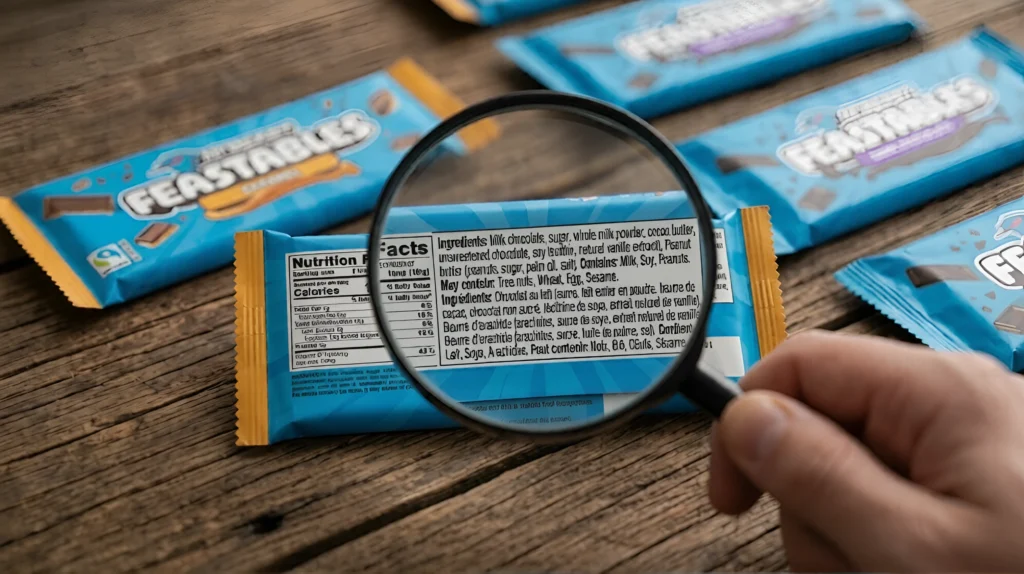
Feastables Halal or Haram? A Complete 2026 Expert Analysis :
The question “Is Feastables halal or haram?” has become increasingly common as the chocolate brand created by YouTube personality MrBeast spreads globally. With its simple branding, minimal ingredient list, and “clean snack” marketing, many Muslim consumers assume it may automatically be halal.
However, in Islam, dietary rulings are not based on branding or popularity. They depend on ingredients, processing methods, contamination risk, and certification status.
This article provides a deep, updated 2026 analysis of Feastables from an Islamic dietary perspective. Instead of giving a rushed answer, we will break everything down step by step so you can make an informed personal decision.
By the end, you will have a clear, practical, and evidence-based understanding of whether Feastables is halal or haram.
What is Feastables?
Feastables is a snack and chocolate brand launched by MrBeast (Jimmy Donaldson). It focuses primarily on chocolate bars with simple ingredients and bold marketing.
The brand’s main selling points include:
- Fewer artificial ingredients
- Simple recipe structure
- Competitive pricing
- Mass global appeal
Popular flavors include:
- Milk Chocolate
- Dark Chocolate
- Almond Chocolate (in some markets)
At first glance, the ingredient list looks “clean,” which leads many people to assume it is automatically halal. But Islamic dietary law requires a deeper analysis.
Islamic Rules for Halal and Haram Food
To determine whether Feastables is halal or haram, we must first understand the Islamic framework.
What Makes Food Halal
Food is halal if:
- It contains no pork or pork-derived ingredients
- It contains no intoxicants (alcohol, etc.)
- Animal-based ingredients are slaughtered according to Islamic law
- No contamination occurs with haram substances
What Makes Food Haram
Food becomes haram if:
- It contains pork gelatin or derivatives
- Alcohol is used as an ingredient (not just trace processing debate)
- Non-halal animal enzymes or fats are used
- Contamination with haram substances is significant
The “Doubtful” Category (Mashbooh)
Many modern processed foods fall into a grey area called mashbooh.
This includes:
- Natural flavorings
- Emulsifiers and stabilizers
- Industrial processing agents
- Shared manufacturing equipment
Feastables fits mainly into this category for analysis purposes.
Related post : Is Haribo Halal or Haram?
Feastables Ingredient Breakdown (Critical Section)
Let’s examine the typical ingredients found in Feastables chocolate bars.
Cocoa & Cocoa Butter
Cocoa is plant-based and completely halal.
No issues
Safe ingredient
Cane Sugar
Sugar is halal, though some scholars discuss bone-char filtering in certain countries.
However:
- It does not make the product haram
- It is widely accepted as halal
Generally halal
Milk Powder (Milk Chocolate Variants)
Milk is halal if sourced from halal animals.
Concerns include:
- Industrial dairy processing
- Cross-contamination risk
However, no inherent haram element exists.
Considered halal
Sunflower Lecithin
This is an emulsifier used to improve texture.
- Derived from sunflower (plant-based)
- No animal origin in most formulations
Fully halal
Natural Flavors (Most Important Section)
This is the key uncertainty factor.
“Natural flavors” may include:
- Plant extracts
- Chemical compounds
- Alcohol-based extraction carriers (in some cases)
Even if alcohol evaporates, scholarly opinions differ:
- Some allow it under transformation (istihalah)
- Others avoid it due to origin concerns
This is the main halal ambiguity point
Manufacturing Process & Cross-Contamination Risk
Even if ingredients are halal, manufacturing conditions matter in Islam.
Feastables is produced through large-scale third-party facilities.
This raises concerns such as:
- Shared production lines with non-halal snacks
- Incomplete purification between production batches
- Lack of halal-specific auditing in some regions
In Islamic law:
- Some scholars tolerate minimal unavoidable contamination
- Others require strict halal-certified separation
This creates moderate uncertainty
Is Feastables Halal Certified?
One of the most important practical questions is certification.
Key Finding:
Feastables is not globally halal-certified across all markets.
This means:
- No universal halal guarantee
- Some regions may have local compliance checks
- No consistent certification logo on all products
Why this matters:
Halal certification ensures:
- Ingredient verification
- Alcohol-free processing confirmation
- Cross-contamination audits
- Supply chain transparency
Without certification, consumers must rely on ingredient interpretation.
Scholarly Opinions on Feastables-Type Products
Islamic scholars usually fall into three approaches.
Strict Opinion (Conservative View)
- Avoid all uncertain ingredients
- “Natural flavors” = not fully safe
- No certification = questionable
Verdict: Better to avoid
Moderate Opinion
- Plant-based ingredients are halal
- Alcohol in processing is often negligible
- No clear haram ingredient = permissible
Verdict: Likely halal
Contextual Modern Fiqh View
- Industrial food systems are complex
- Intentional haram use is what matters most
- Avoid unnecessary hardship in consumption
Verdict: Generally permissible unless proven otherwise
Related post : Are Takis Halal or Haram?
Final Verdict: Feastables Halal or Haram?
After analyzing ingredients, manufacturing, and Islamic perspectives:
Most Accurate Conclusion:
Feastables is halal in ingredients
BUT it is not fully certified halal globally
AND contains minor grey areas (natural flavors + manufacturing)
Simple Answer:
- Not clearly haram
- Not fully certified halal
- Best classified as: “halal-friendly but uncertain”
Practical Decision Guide
You can decide based on your level of caution:
- Strict halal practice → Avoid or wait for certification
- Moderate practice → Generally acceptable
- Flexible approach → Safe based on ingredients
| Factor | Status |
|---|---|
| Pork ingredients | None |
| Alcohol content | Possible trace processing |
| Animal derivatives | Dairy only |
| Certification | Not universal |
| Overall ruling | Halal-friendly but uncertain |
FAQs About Feastables Halal or Haram
Is Feastables halal or haram?
Feastables is not clearly haram, but it is not universally halal-certified. It falls into a halal-friendly but uncertain category.
Does Feastables contain pork or gelatin?
No, Feastables does not contain pork or gelatin in its known ingredient lists.
Is Feastables chocolate halal in Pakistan or Muslim countries?
In many Muslim countries, products may be locally reviewed, but Feastables is not universally certified halal, so caution is advised.
What is the biggest halal concern in Feastables?
The biggest concern is “natural flavors” and lack of certification, not the core ingredients.
Can Muslims eat Feastables?
Yes, many scholars would consider it permissible due to plant-based ingredients, but stricter scholars recommend avoiding uncertified products.
Is Feastables safe for strict halal diets?
If you follow strict halal guidelines, it is better to choose products with official halal certification.
Does Feastables use alcohol in its ingredients?
There is no confirmed direct alcohol ingredient, but some flavoring processes in the food industry may use alcohol as a carrier.
Why is Feastables not fully halal certified?
Because certification depends on regional audits, supply chains, and corporate compliance decisions, which vary globally.
Is Feastables better than other chocolates for halal consumers?
It has a simpler ingredient list than many brands, but simplicity does not automatically equal halal certification.
What is the safest alternative?
Halal-certified chocolate brands available in your region are the safest option for strict compliance.
Conclusion
The halal status of Feastables cannot be defined in absolute black-and-white terms. While the ingredients are largely plant-based and dairy-derived—both generally halal—the lack of universal certification and the uncertainty around “natural flavors” place it in a grey area category.
For Muslim consumers, the decision ultimately depends on personal religious caution level:
- If certainty is required → choose certified halal chocolate
- If moderate flexibility is acceptable → Feastables is likely fine
- If ingredient-based judgment is enough → it is generally permissible
In modern food industries, clarity often depends not just on ingredients—but on certification and transparency, and that is where Feastables remains incomplete for strict halal assurance.
