
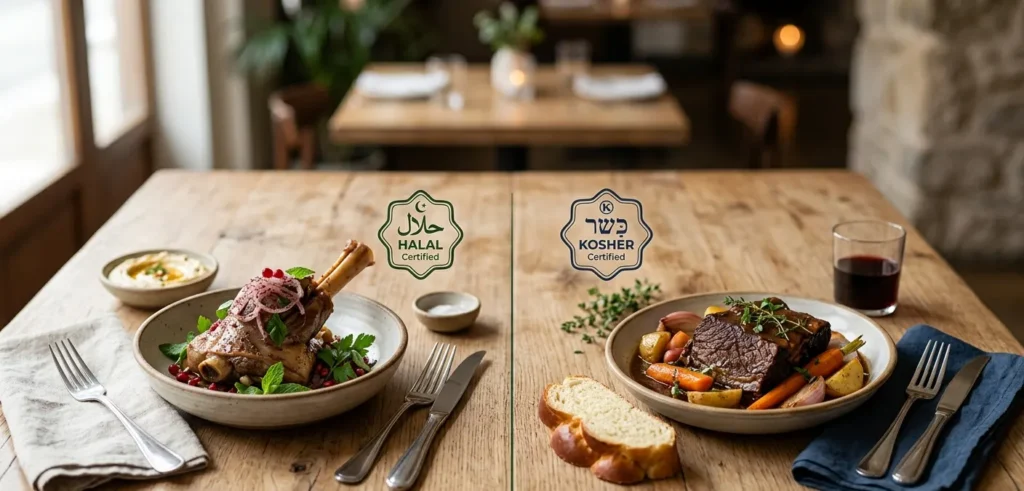
The Difference Between Halal and Kosher:
As the global food industry becomes increasingly interconnected, understanding dietary laws is no longer just a matter of religious observance—it is a critical necessity for consumers, food manufacturers, and restaurateurs alike. Two of the most widely recognized and frequently compared dietary standards are Halal and Kosher.
While both sets of guidelines originate from ancient Abrahamic traditions and share notable similarities—such as the prohibition of pork and strict rules regarding animal slaughter—they are distinct frameworks with their own unique requirements.
Whether you are a consumer trying to navigate a complex food label, a business owner looking to expand your market reach, or simply someone curious about global food cultures, understanding the difference between Halal and Kosher is essential. This guide breaks down the origins, rules, and fundamental distinctions between the two.
What is Halal?
The term Halal is an Arabic word that translates simply to “permissible” or “lawful.” In the context of dietary laws, it refers to food and drink that are permitted for consumption by Muslims under Islamic law (Sharia), as outlined in the Quran and the teachings of the Prophet Muhammad (Sunnah).
The opposite of Halal is Haram, which means “forbidden.”
The Core Principles of Halal
For a food item to be considered Halal, it must meet several strict criteria:
- Lawful Ingredients: The food must not contain any forbidden substances. The most well-known Haram items include pork (and all its by-products, such as gelatin), blood, and any form of intoxicant, including alcohol.
- The Dhabiha (Slaughtering Process): For meat to be Halal, the animal must be slaughtered by a sane adult Muslim. The slaughter must be performed using a razor-sharp knife to swiftly sever the carotid artery, jugular vein, and windpipe to minimize the animal’s suffering.
- The Invocation: Crucially, the slaughterer must invoke the name of Allah (God) by saying “Bismillah” (In the name of God) at the exact moment the animal is slaughtered.
- Animal Welfare: The animal must be healthy and alive at the time of slaughter, and it must have been treated humanely throughout its life.
What is Kosher?
Kosher is a Hebrew word that means “fit” or “proper.” It refers to food that conforms to the strict dietary regulations of traditional Jewish law, known as Kashrut. These laws are derived from the Torah and have been passed down through generations of rabbinic tradition.
Like Halal, Kashrut dictates not only what foods can be eaten but also how they must be produced, processed, and prepared. Food that is not Kosher is referred to as Treif (torn or forbidden).
The Core Principles of Kosher
The laws of Kashrut are extensive, but the foundational rules include:
- Permitted Animals: Land animals must have cloven hooves and chew their cud (e.g., cows, sheep, goats). Pigs have cloven hooves but do not chew their cud, making them strictly forbidden.
- The Shechita (Slaughtering Process): Animals must be slaughtered by a Shochet, a highly trained and pious Jewish slaughterer. The cut is made with an impeccably sharp, smooth blade (a chalef) across the throat to ensure rapid loss of consciousness.
- Removal of Blood: Jewish law strictly forbids the consumption of blood. After slaughter, the meat must undergo a rigorous process of soaking and salting (koshering) to draw out all remaining blood. Certain fats and the sciatic nerve must also be removed.
- Separation of Meat and Dairy: One of the most defining characteristics of a Kosher diet is the strict separation of meat (fleishig) and dairy (milchig). They cannot be cooked together, eaten together, or even prepared using the same utensils or cookware.
Key Differences Between Halal and Kosher
While both dietary laws require religious supervision over meat and forbid the consumption of pork, the nuances of their restrictions reveal significant differences.
Related post : Halal Bites in the U.S. 2026
1. The Blessing During Slaughter
- Halal: A prayer dedicating the animal to God (Bismillah) must be recited over each individual animal as it is being slaughtered.
- Kosher: The Shochet recites a blessing before commencing the slaughtering process, but does not need to repeat the blessing for every single animal if they are slaughtering a continuous batch.
2. Meat and Dairy Combinations
- Halal: Islam places absolutely no restrictions on mixing meat and dairy. A Muslim can freely eat a cheeseburger or a creamy chicken dish, provided both the meat and the dairy are individually Halal.
- Kosher: Mixing meat and dairy is entirely forbidden. Kosher households often have two completely separate sets of dishes, pots, and even sinks to ensure the two never cross-contaminate.
3. Alcohol and Intoxicants
- Halal: All intoxicating substances, including all forms of alcohol, are strictly Haram. This includes using wine for cooking, or consuming foods with alcohol-based vanilla extract.
- Kosher: Alcohol is widely permitted and even plays a vital role in Jewish religious ceremonies. However, certain alcoholic beverages, particularly wine and grape juice, must be produced under strict rabbinic supervision to be certified Kosher.
4. Seafood and Aquatic Life
- Halal: The general consensus in Islamic jurisprudence is that everything from the sea is Halal. While some specific schools of thought have minor restrictions on bottom-feeders, fish, shellfish, crustaceans, and mollusks are widely accepted.
- Kosher: For seafood to be Kosher, the creature must have both fins and scales. Therefore, salmon, tuna, and cod are permitted, but all shellfish—including shrimp, lobster, crab, clams, and oysters—are strictly forbidden. Catfish and eel are also prohibited because they lack true scales.
Related post : Is Shrimp Halal or Haram?
5. Gelatin and Additives
Both diets require scrutiny of food additives like gelatin, enzymes, and emulsifiers. However, Kosher certification often allows for certain animal-derived enzymes (like rennet used in cheese) even if the animal wasn’t slaughtered kosher, provided it is heavily processed. Halal guidelines generally require that any animal by-product comes from a Halal-slaughtered animal.
Comparison Tables for Quick Reference
To simplify these complex dietary laws, here is a visual breakdown of how Halal and Kosher compare on a practical level.
Halal vs. Kosher at a Glance
| Feature/Requirement | Halal (Islamic Law) | Kosher (Jewish Law) |
| Primary Text | Quran and Sunnah | Torah (Kashrut) |
| Slaughter Method | Dhabiha | Shechita |
| Who Slaughters? | Sane adult Muslim | Shochet (Trained Jewish slaughterer) |
| Blessing on Animal | Required for each animal | Required before the batch begins |
| Pork Allowed? | No | No |
| Mixing Meat & Dairy? | Permitted | Strictly Prohibited |
| Alcohol Allowed? | Strictly Prohibited | Permitted (if Kosher certified) |
| Blood Consumption? | Prohibited (drained) | Prohibited (requires soaking & salting) |
Permitted vs. Prohibited Foods
| Food Category | Is it Halal? | Is it Kosher? |
| Beef / Lamb / Chicken | Yes (if Dhabiha) | Yes (if Shechita) |
| Pork / Bacon | No | No |
| Shrimp / Lobster / Crab | Yes (for most Muslims) | No |
| Salmon / Tuna | Yes | Yes |
| Cheeseburger | Yes (if meat is Halal) | No (mixing meat and dairy) |
| Kosher Wine | No (alcohol is forbidden) | Yes |
| Rabbit / Camel | Yes | No |
| Insects | No (Except Locusts) | No (Except specific Locusts) |
Cross-Dietary Compatibility
A common question that arises in both religious and commercial circles is whether the followers of one faith can consume the certified food of the other.
Can Muslims Eat Kosher Food?
In many cases, yes. Islamic law permits the consumption of food prepared by the “People of the Book” (Jews and Christians), provided the food does not contain any inherently Haram ingredients (like alcohol). Therefore, a Muslim can generally eat Kosher-certified meat (as the slaughter methods are similar) and Kosher-certified vegetarian items. However, a Muslim must still check the ingredients to ensure no Kosher wine or alcohol was used in the preparation.
Can Jewish People Eat Halal Food?
Generally, no. The rules of Kashrut are significantly stricter regarding the handling of meat, the specific removal of blood via salting, and the prohibition of certain fats and nerves. Furthermore, Halal slaughter does not meet the specific rabbinic requirements of the Shechita. Therefore, a Jewish person strictly observing Kashrut cannot substitute Kosher meat with Halal meat.
The Importance of Certification in the Food Industry
For food brands, understanding the difference between Halal and Kosher is a massive commercial opportunity. The global Halal food market and the Kosher food market represent hundreds of billions of dollars combined.
Achieving certification from recognized bodies (such as the Orthodox Union for Kosher or various regional Halal certifiers like IFANCA) builds immense trust with consumers. It tells the buyer that a third-party expert has audited the supply chain down to the molecular level, ensuring that no cross-contamination has occurred. Interestingly, many consumers who are neither Muslim nor Jewish seek out Kosher and Halal labels, viewing them as a mark of superior food safety, hygiene, and ethical animal treatment.
Frequently Asked Questions (FAQs)
Is Kosher meat automatically Halal?
While many Muslims do consume Kosher meat because the slaughter processes are similar, it is not “automatically” Halal. Muslims must still ensure that no alcohol or wine was used in the cooking process. Some strict Islamic scholars also argue that because the name of Allah is not recited over every animal during Kosher slaughter, it does not perfectly meet Halal standards.
Why are both diets so strict against pork?
Both the Torah and the Quran explicitly forbid the consumption of pork. While modern science points to pigs carrying certain parasites, the primary reason followers of both faiths avoid pork is simple obedience to divine commandment.
Are all vegan foods both Halal and Kosher?
Mostly, yes. A strictly vegan diet naturally avoids the complex laws surrounding meat slaughter and the mixing of meat and dairy. However, to be officially certified, the facility producing the vegan food must be inspected to ensure there is no cross-contamination with non-Halal or non-Kosher equipment, and that no hidden alcohols or grape-derivatives were used.
Which is stricter, Halal or Kosher?
It depends on the specific rule. Kosher is much stricter regarding the preparation of meat (soaking and salting), seafood (no shellfish), and the complete separation of meat and dairy. However, Halal is infinitely stricter regarding alcohol, banning it entirely in any form, whereas Kosher permits it.
Does “Pareve” mean Halal?
“Pareve” is a Kosher term meaning the food contains neither meat nor dairy. While Pareve foods (like fruits, vegetables, and grains) are generally safe for Muslims to eat, a Muslim must still verify that the Pareve food does not contain any alcohol.
Conclusion
While Halal and Kosher are often grouped together as religious dietary laws, they are distinct systems built upon different theological foundations. Kosher focuses heavily on strict separation and precise preparation methods to maintain spiritual purity, while Halal emphasizes the lawfulness of the substance itself and the dedication of the sustenance to God.
Understanding the difference between Halal and Kosher allows for greater cultural respect and enables consumers to make informed choices. For businesses, navigating these dietary laws with professionalism and accuracy is the key to unlocking highly loyal, values-driven global markets
For more like this visit : Hilalinfohub
