
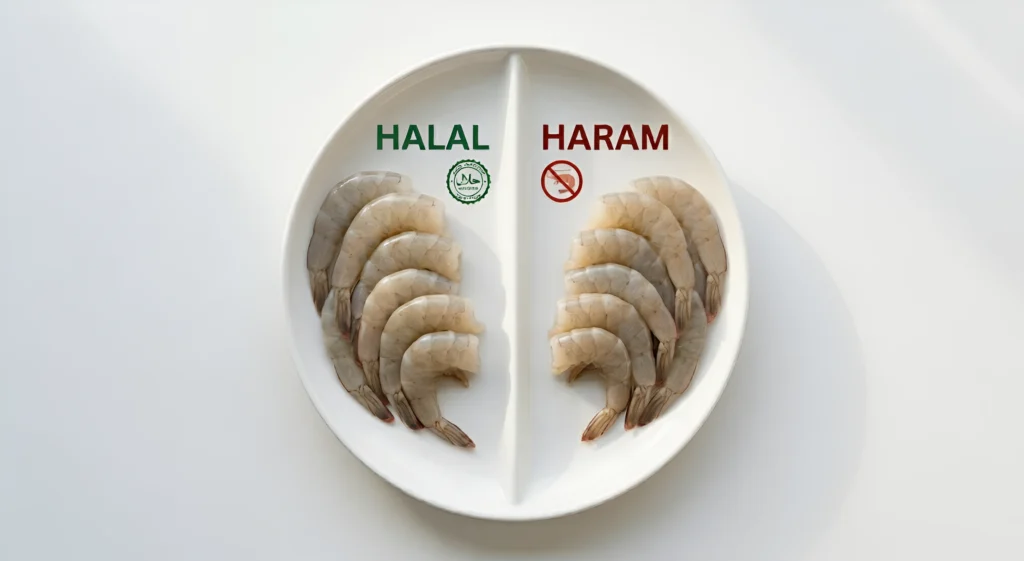
Introduction: Why the Question About Prawns Matters
Seafood is often considered one of the simplest categories of food in Islam—but when it comes to specific creatures like prawns, confusion begins. While many Muslims enjoy seafood freely, others hesitate when it comes to shellfish. This leads to a frequently asked question: Are prawns halal or haram?
Unlike clear-cut rulings on pork or alcohol, seafood falls into an area where different Islamic schools of thought interpret the evidence differently. As a result, prawns are considered halal by some scholars and questionable or even impermissible by others.
This article takes a comprehensive and balanced approach, examining Quranic verses, Hadith, scholarly opinions, and modern interpretations to help you understand the issue in depth.
Understanding the General Rule of Seafood in Islam
To begin, we must look at the primary source: the Quran. Allah says:
“Lawful to you is what you catch from the sea and use for food…” (Surah Al-Ma’idah 5:96)
This verse is often cited as evidence that seafood is broadly permissible. However, the interpretation of what counts as “seafood” varies among scholars.
Another important Hadith states:
“Its water is pure and its dead are lawful.”
This Hadith refers to the sea, suggesting that marine life is generally permissible to consume—even without slaughter.
The Core Issue: What Exactly Are Prawns?
The debate largely depends on how prawns are classified. Are they:
- Fish?
- A separate category of sea creatures?
- Similar to insects or land animals?
Prawns are crustaceans, closely related to shrimp, crabs, and lobsters. They have shells and live in water, but they are not technically fish. This classification is the root of اختلاف (difference of opinion).
The Four Major Schools of Thought
Hanafi School
The Hanafi school is the most restrictive when it comes to seafood. According to many Hanafi scholars:
- Only fish are clearly halal
- Creatures that are not classified as fish may be considered makruh (disliked) or even haram
However, there is internal debate within the Hanafi school regarding prawns. Some scholars argue that prawns resemble fish closely enough to be considered permissible.
Common Hanafi Position:
- Prawns are makruh tahrimi (strongly disliked) or borderline halal
- Some modern Hanafi scholars consider them halal due to their classification as a type of aquatic creature similar to fish
Shafi’i School
The Shafi’i school takes a broader approach. According to this view:
- All sea creatures are halal, regardless of type
This includes:
- Fish
- Shellfish
- Crustaceans like prawns
Conclusion (Shafi’i):
Prawns are completely halal
Maliki School
The Maliki school is similar to the Shafi’i position, with even fewer restrictions:
- All marine life is considered halal
- No distinction is made between fish and other sea creatures
Conclusion (Maliki):
Prawns are halal without any doubt
Hanbali School
The Hanbali school also supports the permissibility of all sea creatures:
- Based on general Quranic allowance
- Includes shellfish and crustaceans
Conclusion (Hanbali):
Prawns are halal
Related post : Is Hibachi Halal?
Why Is There اختلاف (Difference of Opinion)?
The اختلاف arises from how scholars interpret:
- The definition of “fish”
- The scope of Quranic permission
- Linguistic and biological classifications
The Hanafi school tends to be more cautious, while the other three schools adopt a broader interpretation.
Modern Scholarly Opinions
In today’s world, many contemporary scholars revisit classical rulings using modern scientific classification.
Some key points from modern discussions:
- Prawns are fully aquatic and cannot survive outside water
- They share many characteristics with fish
- They are widely consumed in Muslim-majority countries
As a result, many modern scholars—even within the Hanafi tradition—lean toward permissibility.
Cultural Practices Across the Muslim World
Interestingly, how Muslims treat prawns often depends on where they live:
- In South Asia (Pakistan, India): Some Hanafi communities avoid prawns, while others consume them
- In Middle Eastern countries: Prawns are widely eaten without concern
- In Southeast Asia: Considered fully halal
- In Western countries: Most Muslims follow the broader opinion and consume prawns
This shows that cultural interpretation often aligns with specific schools of thought.
Nutritional and Practical Considerations
While the ruling is primarily religious, it’s also helpful to understand that prawns are:
- High in protein
- Rich in vitamins and minerals
- Widely used in global cuisine
From a non-religious perspective, they are considered a healthy food option.
The Principle of Caution in Islam
Islam encourages believers to avoid doubtful matters when possible. The Prophet Muhammad (peace be upon him) said:
“Whoever avoids doubtful matters clears himself in regard to his religion and his honor.”
This principle is especially relevant for those who follow stricter interpretations.
So, Are Prawns Halal or Haram?
Let’s summarize clearly:
- Shafi’i, Maliki, Hanbali schools: Halal
- Hanafi school: اختلاف (difference of opinion), often considered makruh or permissible depending on interpretation
Practical Guidance for Muslims
If you’re unsure about whether to eat prawns, here are some practical approaches:
Follow Your Madhab
Stick to the ruling of your school of thought.
Choose the Safer Option
If you feel doubtful, avoid it.
Respect Differences
Understand that اختلاف is a natural part of Islamic scholarship.
Seek Knowledge
Consult trusted scholars if needed.
Related post : Is Octopus Halal in Islam?
Common Misconceptions
“Prawns Are Definitely Haram”
This is incorrect. The majority of scholars consider them halal.
“All Seafood Is Halal Without Exception”
Not according to the Hanafi school.
“Prawns Are Like Insects”
Scientifically and Islamically, they are classified as marine creatures, not insects.
Final Verdict
The ruling on prawns depends largely on which Islamic school of thought you follow:
- If you follow Shafi’i, Maliki, or Hanbali, prawns are halal
- If you follow Hanafi, there is a difference of opinion, but many scholars allow them
Overall Conclusion:
Prawns are considered halal by the majority of Islamic scholars, though some caution exists within the Hanafi school.
Frequently Asked Questions
Are prawns halal in Islam?
Yes, according to the majority of scholars, prawns are halal.
Why do some Muslims avoid prawns?
Because certain Hanafi scholars consider them doubtful or makruh.
Are prawns considered fish?
Scientifically no, but some scholars classify them similarly for permissibility.
Can Hanafi Muslims eat prawns?
There is difference of opinion; some allow it, others discourage it.
Are shrimp and prawns the same ruling?
Yes, they generally share the same ruling in Islamic law.
Conclusion
The question “Are prawns halal or haram?” highlights the beauty and complexity of Islamic jurisprudence. While the Quran provides general guidance, scholarly interpretation allows flexibility based on evidence and reasoning.
For most Muslims around the world, prawns are a permissible and commonly enjoyed food. However, those who follow stricter interpretations are equally justified in their caution.
Ultimately, Islam provides room for اختلاف while encouraging sincerity, knowledge, and respect for differing views.
