When it comes to candy, jelly beans are a staple. But for Muslims, the “jelly” part often rings alarm bells. Is it made of gelatin? Is that gelatin from a pig? As of 2026, the world of jelly beans has become more diverse, with some brands going fully halal and others remaining strictly haram.
Short answer: It depends entirely on the brand. Many traditional jelly beans are gelatin-free, but they may still contain “mashbooh” (doubtful) ingredients like shellac or carmine.
Quick Answer: The 2026 Cheat Sheet
- Most Jelly Beans = Gelatin-free (Uses cornstarch instead)
- Jelly Belly = Mushbooh (No gelatin, but contains insect-based shellac and carmine)
- The Jelly Bean Factory = Halal Certified (Uses plant-based starch)
- Traditional Gummies = Often Haram (Usually contains pork gelatin)
- Overall Verdict = Generally halal-friendly, but you must check the “Glazing Agents.”
Why Most Jelly Beans Are Different from Gummy Bears
Most people assume jelly beans are made like gummy bears. However, the “jelly” in a jelly bean is usually achieved through cornstarch or pectin, not gelatin.
- Gelatin (Haram Source): Usually derived from pig skin or non-halal beef.
- Cornstarch (Halal): A plant-based thickener used in high-quality jelly beans to create that chewy center.
Since most major jelly bean brands skip the gelatin, they are often safer for Muslims than other chewy candies. But the shell is where the real mystery lies.
Ingredient Analysis: The Halal vs. Haram Breakdown
| Ingredient | Source | Status | Muslim Guide Note |
| Sugar / Corn Syrup | Plant | Halal | Safe base. |
| Cornstarch / Pectin | Plant | Halal | The secret to the chewiness. |
| Confectioner’s Glaze (E904) | Insect (Lac) | Doubtful | Also known as Shellac. Some scholars allow it; others avoid it. |
| Carmine (E120) | Insect (Cochineal) | Haram | A red dye made from crushed bugs. Strictly forbidden in most schools of thought. |
| Beeswax (E901) | Bees | Halal | Generally accepted as permissible. |
| Carnauba Wax (E903) | Plant (Palm) | Halal | The safest vegan/halal glazing option. |
The Big Brands: 2026 Status Report
Jelly Belly (The “Mushbooh” Giant)
Jelly Belly is the most famous brand. While they do not use gelatin, they are not officially Halal Certified.
- The Problem: They use Shellac (E904) for the shine and Carmine (E120) for red/pink beans (like Very Cherry).
- The Verdict: Many Muslims avoid the red flavors. If you are strict about insect-derived ingredients, Jelly Belly is considered Mashbooh (doubtful).
The Jelly Bean Factory (The Halal Hero)
This brand has taken the lead in 2026 by ensuring their entire range is Halal Certified.
- Why it’s safe: They use starch-based centers and avoid haram dyes.
- The Verdict: 100% Halal. Safe to eat without checking every bean.
Store Brands (Generic)
Cheaper “no-name” jelly beans are more likely to use Gelatin (E441) to save costs. Always read the back of the bag for “Gelatine” or “E441.” If it doesn’t specify “Beef” or “Halal,” assume it is porcine (pork).
Understanding the “Shellac” Controversy
The most common question in 2026 is: “Is Shellac (E904) halal?”
Shellac is a resin secreted by the female lac bug.
- The Permissible View: Some scholars argue it is a secretion (like honey) and does not involve eating the actual insect.
- The Precautionary View: Other scholars argue that because the bug is often killed in the harvesting process, the resin is “Najis” (impure).
- Action Plan: If the package says “Suitable for Vegetarians,” it usually contains Shellac. If it says “Vegan,” it is Shellac-free.
How to Identify Halal Jelly Beans
- Look for the “V”: A Vegan label is your best friend. It guarantees no gelatin, no shellac, and no carmine.
- Check for “E120”: If you see E120 or “Carmine/Cochineal,” put the bag back.
- The Squish Test: If the bean is extremely rubbery and stretchy (like a gummy bear), it likely has gelatin. Real jelly beans should have a grainy, starch-like break when bitten.
Halal Status of Jelly Beans by Country (2026 Guide)
| Country / Region | Can You Eat It? | The Honest Truth |
| Middle East (UAE, Saudi, etc.) | YES (Safe) | Everything on the shelf is Halal by law. You don’t even need to read the label! |
| Malaysia & Indonesia | YES (Safe) | Almost all brands are officially Halal-certified (look for the JAKIM or MUI logos). |
| United Kingdom | PROBABLY | Most brands are “Vegetarian Friendly” (no gelatin). Just check for E120 (insect dye) in the red ones. |
| United States | CAUTION | Brands like Jelly Belly have no gelatin, but they use Carmine (crushed bugs). Some store brands still use Pork Gelatin. |
| Europe (Germany/France) | CHECK LABEL | Be careful with Haribo jelly beans here; they often use pork gelatin unless there is a specific “Halal” sticker. |
| Australia / NZ | LIKELY SAFE | Most “Gourmet” beans use starch, but always scan for E120 or Shellac if you avoid insect products. |
Regional Differences: A Global Map
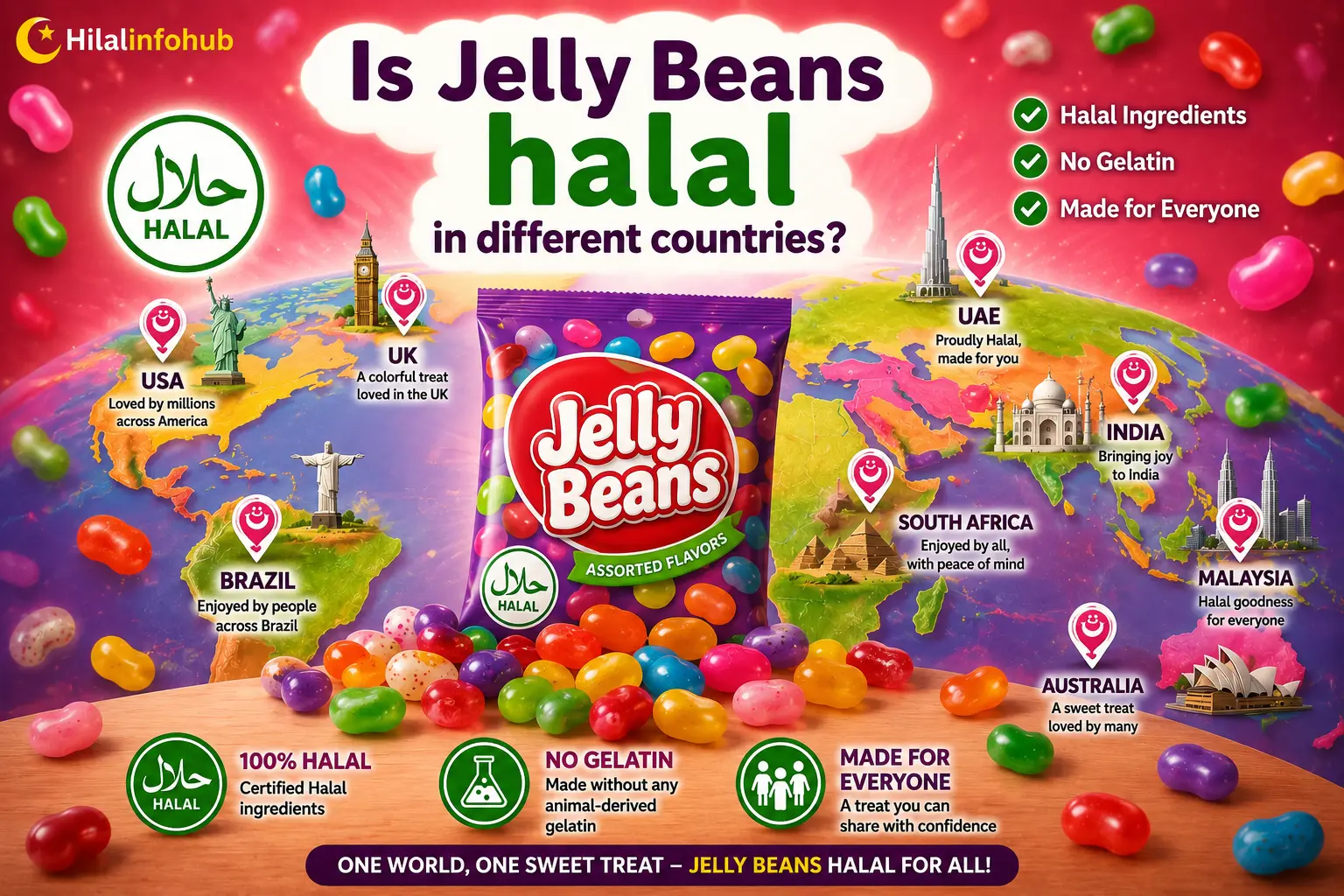
- USA & Canada: Manufacturers are not required to state the source of “Gelatin” or “Glycerin.” Unless it says “Halal” or “Vegan,” there is a high risk of haram ingredients.
- United Kingdom & EU: Labels are much clearer. Look for the “V” symbol. Most UK jelly beans are plant-based to cater to the large Hindu and Muslim populations.
- Middle East (GCC): Any jelly beans sold in supermarkets in Saudi Arabia, UAE, or Qatar are required by law to be Halal. Even brands like Jelly Belly produced for these markets often change their recipe to be Halal-compliant.
- South Asia (Pakistan/India): Local brands are almost always Halal (using starch). For imported brands, always check for a “Halal Sticker” applied by the importer.
Real-Life Scenario: What Should You Eat?
A common misconception about jelly beans is that they always contain gelatin. In reality, many good-quality brands use cornstarch instead. However, it’s still important to be careful with red-colored flavors, as they often contain “carmine,” which is made from insects.
If you want to be on the safe side, it’s best to go for The Jelly Bean Factory or any brand that is clearly vegan-certified.
Related post : Is KitKat Halal or Haram? Complete Muslim Guide 2026
Ingredient Analysis: The “Red Flags” for 2026
When reading a label in 2026, look for these specific codes and names. We have categorized them by their Halal status.
Category A: Strictly Haram (Avoid Completely)
- Gelatine (E441): Unless specified as “Halal Bovine Gelatine.”
- Carmine / Cochineal (E120): This is a vibrant red pigment made by crushing the female Cochineal insect. Under the Hanafi school and most mainstream contemporary Fatwas, consuming insects is Haram.
- Animal Shortening: Occasionally found in “gourmet” or chocolate-covered jelly beans.
Brand Analysis: Who Passes the Test?
Jelly Belly: The World Leader
Jelly Belly is the most requested brand. According to their 2026 dietary statements:
- Gelatin Status: They do not use gelatin in their jelly beans.
- The Problem: They use Shellac and Beeswax for glazing. More importantly, many of their red and purple flavors (like Raspberry, Pomegranate, and Very Cherry) contain Carmine (E120).
- Verdict: Most scholars classify Jelly Belly as Mashbooh. While not “Haram” due to pork, the use of crushed insects (Carmine) makes many of their flavors forbidden for strict observers.
Explore More Halal & Haram Food Guides.
- Is Twizzlers Halal or Haram? Complete Muslim Guide 2026
- Is Airheads Halal or Haram? Complete Muslim Guide 2026
- Is Swedish Fish Halal or Haram? Complete Muslim Guide 2026
- Is Twix Halal or Haram? Complete Muslim Guide 2026
FAQs
Do Jelly Belly beans have pork?
No. Jelly Belly confirms they use no animal-derived gelatin or pork fats.
Are Starburst Jelly Beans halal?
In the US, they often contain gelatin. In other regions, they may use starch. You must check the label for “Gelatin.”
Is Shellac haram?
It is a “gray area” (Mashbooh). Most mainstream scholars allow it, but many cautious Muslims prefer to avoid it.
Are “Alcohol” flavored jelly beans halal?
Most use synthetic flavorings and contain 0% alcohol. However, check the brand—Jelly Bean Factory’s cocktail flavors are 100% alcohol-free and halal.
Final Verdict 2026
Vegetarian/Vegan Jelly Beans = Halal
Red/Pink Jelly Beans (with E120) = Haram
Gelatin-based Jelly Beans = Haram (unless certified beef)
Conclusion
Jelly beans are much safer for the Muslim diet than gummy candies, but they aren’t a “free pass.” By 2026, many brands have switched to plant-based ingredients to capture a wider market. To stay safe, prioritize Vegan or Halal-Certified brands. When in doubt, avoid the red ones and stick to flavors like lemon, lime, and orange, which rarely use insect-based dyes.
Always remember to check the ingredient list carefully before buying, because formulations can vary from country to country and even between batches. A quick look for halal certification or a vegan label can save you from doubtful ingredients and make your choice much easier.
