
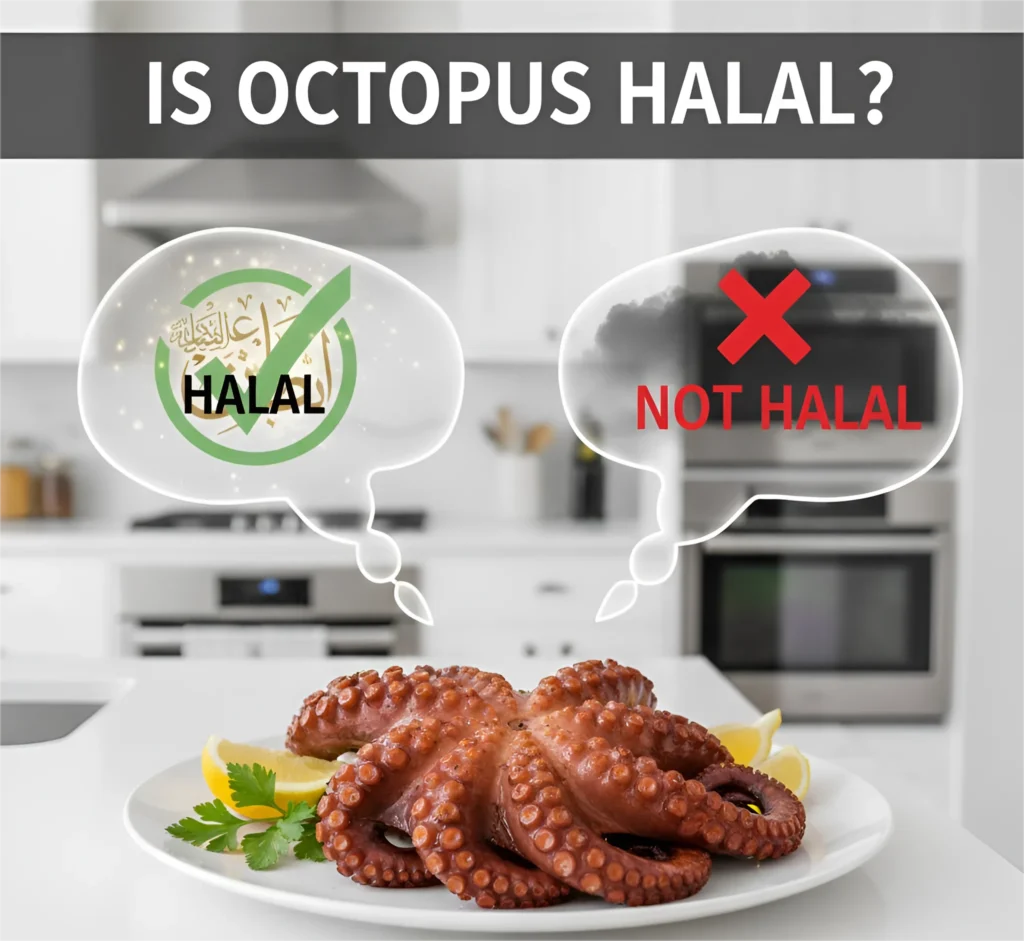
Seafood is one of the most debated areas of halal food, especially when it comes to creatures that aren’t typical “fish.” One of the most commonly asked questions is: Is octopus halal?
Some Muslims eat octopus freely, others avoid it, and some are unsure because of different opinions in Islamic schools of thought. In this detailed guide, we’ll explore the Islamic ruling on octopus, the evidence used by scholars, how each major school of thought views it, and what modern scholars say today.
By the end, you’ll have a clear and confident answer — based on authentic knowledge — about whether octopus is halal in Islam.
Why Octopus Causes Confusion in Halal Food
Octopus isn’t a typical fish, and it doesn’t have scales or fins. It has a unique appearance and is classified as a mollusk or cephalopod, similar to squid and cuttlefish.
Islamic scholars throughout history have agreed on fish being halal, but when it comes to sea creatures like octopus, crab, shrimp, squid, lobster, and others, there has always been some difference of opinion.
This difference doesn’t come from uncertainty, but because Islamic schools of law interpret Qur’anic verses on seafood differently.
Before examining each school, let’s look at what the Qur’an and Hadith say about seafood in general.
The Qur’an’s Ruling on Seafood
The primary verse that scholars refer to when discussing seafood is:
Surah Al-Ma’idah (5:96)
“Lawful to you is game from the sea and its food as provision for you and for travelers…”
This verse means that:
- Sea animals are halal
- Seafood is a blessing
- Water-based creatures are permissible
But does this include all creatures of the sea — such as octopus — or only fish?
This is where scholars differ slightly.
Hadith Evidence on Seafood
Another important text is the hadith:
“Its (the sea’s) water is pure and its dead are lawful.”
— Abu Dawood, Tirmidhi
This hadith clearly states that sea creatures are permissible. However, scholars still debated whether this applies to all sea creatures or only those commonly recognized as fish.
To answer “Is octopus halal?” properly, we need to look at the interpretations of each Islamic school.
The Ruling on Octopus According to Each Islamic School of Law
Islam has four major schools of Sunni fiqh: Hanafi, Shafi’i, Maliki, and Hanbali. All four accept fish as halal, but they differ on non-fish creatures like octopus.
Let’s break it down clearly:
Shafi’i, Maliki, and Hanbali Schools
Ruling:
Octopus is halal.
These three schools believe that:
- All sea creatures are halal unless harmful
- Octopus lives in water
- It is considered part of “game from the sea”
They take the verse in Surah Al-Ma’idah literally: all seafood is permissible.
Therefore, according to the majority of Islamic schools, octopus is completely halal.
Hanafi School
Ruling:
Octopus is considered makruh (disliked) but not haram.
The Hanafi school restricts halal seafood to:
- Fish
- Shrimp (according to many modern Hanafi scholars)
Because octopus is not a “fish,” classical Hanafi scholars classify it as makruh, meaning:
- Not recommended
- Disliked
- But not forbidden
Makruh ≠ haram.
This means a Hanafi Muslim is not sinful for eating octopus — but it may be something better avoided based on classical Hanafi advice.
However:
Many modern Hanafi scholars now consider octopus halal, given that:
- It is pure
- It lives entirely in water
- It is widely consumed today
- The majority of scholars permit it
So even within the Hanafi school, the view is shifting.
Why Some Scholars Consider Octopus Halal
Scholars who permit octopus (most of them) use these arguments:
1. Qur’an says seafood is lawful
The verse in Surah Al-Ma’idah is broad and does not limit permissibility to fish.
2. Octopus lives entirely in water
It is not a land animal, so it has the ruling of sea creatures.
3. It does not require slaughter
Sea creatures do not require dhabiha.
4. No evidence forbids it
Islam prohibits harmful or impure things. Octopus does not fall into either category.
5. The Prophet (ﷺ) allowed “seafood” generally
Not just fish.
Thus, the reasoning for permissibility is strong.
Why Some Scholars Consider Octopus Disliked (Makruh)
Mainly the Hanafi school holds this view.
Their argument is based on classification:
According to classical Hanafi fiqh:
Only animals that are considered “fish” are halal from the sea.
Since octopus is:
- A mollusk
- Not a fish
- Not something traditionally eaten in early Islamic regions
It was classified as makruh, not haram.
However, many modern Hanafis now disagree with the older view because:
- Seafood is safe
- Food culture has changed globally
- The Qur’anic verse is broad
- The Prophet (ﷺ) permitted “seafood,” not just fish
So even in the Hanafi school, opinions are changing.
Is Octopus Halal in Modern Islamic Rulings?
Most contemporary Islamic councils say:
Yes, octopus is halal.
They base this on:
- General Qur’anic permissibility
- No evidence of prohibition
- Widespread modern consumption
- Clear ruling from three major schools
Some Hanafi councils still classify it as disliked, but not forbidden.
Final judgment in modern times:
Majority of scholars: halal
Some Hanafis: makruh
Does Octopus Need to Be Slaughtered Islamically?
No.
Like fish and other sea creatures, octopus does not require Islamic slaughter.
The Prophet (ﷺ) said:
“Its dead are lawful.”
This applies to sea animals, meaning:
- No dhabiha required
- No need for a Muslim to kill it
- No specific conditions
- Dead octopus is halal (unless spoiled)
What About Eating Raw Octopus? (Sushi, Sashimi, etc.)
Eating octopus raw is halal as long as:
- It is safe
- It is not harmful
- It is fresh
Islam’s rule is to avoid harm — not to avoid raw food.
So octopus sushi, takoyaki, sashimi, and grilled octopus are all halal if the octopus itself is halal.
Health Benefits of Octopus
Octopus is not only permissible—it’s healthy.
Nutritional benefits:
- High-quality protein
- Low in fat
- Rich in vitamin B12
- High in iron and selenium
- Contains omega-3 fatty acids
Islam encourages eating pure and wholesome food, so octopus fits this principle.
FAQs
Is it haram to eat octopus?
No. The majority of scholars say octopus is halal.
Is octopus halal for Hanafis?
It is considered makruh (disliked) by classical Hanafi scholars but not haram. Many modern Hanafis say it is halal.
Do octopuses need to be slaughtered Islamically?
No. Sea creatures do not require slaughter.
Is squid also halal?
Yes — majority says halal. Hanafis say makruh.
What about lobster and crab?
Halal in most schools. Makruh in Hanafi fiqh.
See Also: Is Trading Haram in Islam? Halal or Haram Guide
Conclusion
After examining Quranic guidance, authentic hadith, and scholarly interpretations, the ruling on octopus becomes clearer. The majority of Islamic scholars consider seafood to be generally permissible, based on clear verses that allow what comes from the sea. Since octopus is a sea creature and not explicitly prohibited in any authentic Islamic source, many scholars classify it as halal. There is no direct evidence declaring it haram, which strengthens the position of permissibility.
However, differences of opinion may exist in certain schools of thought, particularly regarding specific types of sea animals. For this reason, Muslims are encouraged to follow the guidance of their trusted scholars or local religious authorities. Overall, based on the dominant scholarly view, octopus is widely regarded as halal, allowing Muslims to consume it with confidence while remaining mindful of their school of thought.
For more like this visit : Hilalinfohub
