Introduction:
The global halal food industry, valued at over $2 trillion, is one of the fastest-growing sectors in the world. Once seen as a niche market serving Muslim consumers, halal products are now embraced globally for their quality, ethical sourcing, and safety standards.
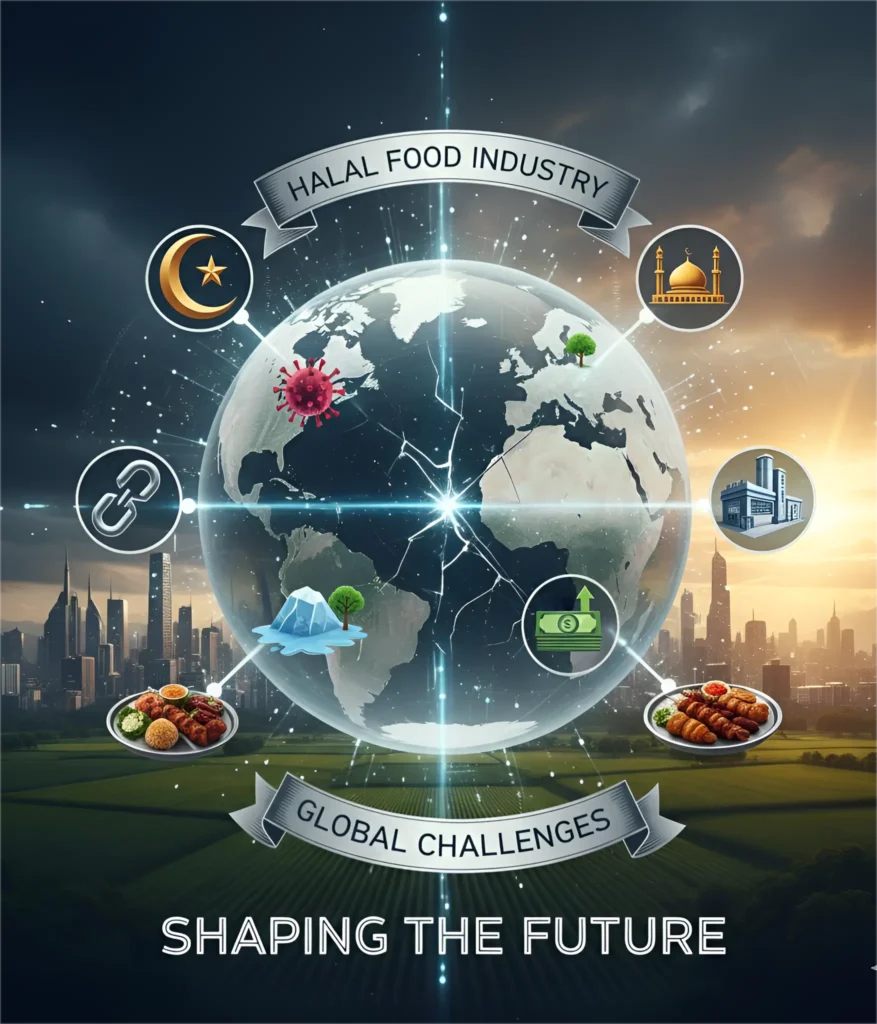
However, like all major industries, the halal food sector is not immune to global challenges. From supply chain disruptions and economic instability to climate change and shifting consumer expectations, the industry faces a complex mix of pressures that could redefine its future.
In this article, we’ll explore how global challenges are affecting the halal food industry, and what businesses, governments, and consumers can do to adapt to a rapidly changing world.
Supply Chain Disruptions and Their Impact
The Global Supply Chain Crisis
The COVID-19 pandemic, geopolitical conflicts, and rising transportation costs have reshaped global trade. These disruptions have had a direct impact on halal food production and distribution, especially in regions that rely heavily on imported ingredients or livestock.
Halal certification requires strict oversight from production to packaging. When supply chains are disrupted, verifying the halal integrity of ingredients becomes difficult. For example, a delay in importing certified halal meat or a shortage of approved slaughter facilities can lead to bottlenecks that affect product availability worldwide.
The Importance of Local Halal Supply Chains
To counter these challenges, many countries are investing in local halal supply chains. Nations like Malaysia, Indonesia, and the UAE are building integrated halal hubs that manage everything from farming and processing to certification.
By developing local halal ecosystems, countries not only strengthen food security but also reduce dependency on international suppliers. This shift toward localization may well define the next phase of growth for the halal industry.
Inflation and Economic Instability
Rising Costs Across the Board
Inflation has affected nearly every industry, and halal food is no exception. Higher energy prices, increased feed costs, and labor shortages have made food production more expensive. For halal producers, who must already meet stringent compliance and certification costs, this financial strain can be particularly challenging.
Consumers are also feeling the pinch. In some markets, halal food—once considered affordable—has become more expensive, forcing lower-income families to adjust their dietary habits.
Adapting to the Economic Climate
To stay competitive, halal businesses are adopting new strategies:
- Efficiency improvements in production and logistics.
- Digitalization, such as e-commerce and mobile ordering.
- Private labeling to reduce costs while maintaining halal integrity.
Additionally, government-backed programs that subsidize halal certification or encourage small and medium enterprises (SMEs) are playing a crucial role in helping the industry weather economic turbulence.
Climate Change and Sustainability
Environmental Pressures
The halal food industry, like all sectors of agriculture and food production, faces increasing pressure to operate sustainably. Climate change has affected crop yields, water availability, and livestock health—all of which have a direct impact on halal food supply.
In regions like the Middle East, North Africa, and parts of Southeast Asia, extreme weather patterns are making food production less predictable. These changes pose a significant risk to food security, especially for countries that rely on imports.
Halal and Sustainability: A Natural Alignment
Interestingly, the principles of halal align well with sustainability. Halal emphasizes cleanliness, animal welfare, and waste minimization. Many halal producers are now expanding these ethical principles to include eco-friendly packaging, responsible sourcing, and carbon reduction initiatives.
For instance, some halal meat producers are adopting regenerative farming methods, while halal-certified brands are introducing plant-based or lab-grown halal alternatives to reduce environmental impact.
The integration of Islamic ethics with green innovation could position the halal industry as a leader in sustainable food production worldwide.
Geopolitical Tensions and Trade Barriers
Export Restrictions and Regulatory Challenges
Global political tensions—such as trade wars and sanctions—have made it harder for some countries to export halal products. For example, differing halal certification standards across nations often create confusion and limit market access.
Currently, there is no single, globally recognized halal certification body. This lack of harmonization means that what’s considered halal in Malaysia may not automatically be accepted in Saudi Arabia or the European Union.
Toward Standardization
Efforts are underway to create mutual recognition agreements between countries, simplifying trade and certification. Organizations like the Organisation of Islamic Cooperation (OIC) are promoting unified halal standards that can be applied globally.
If successful, these initiatives could make cross-border halal trade more efficient, transparent, and profitable.
Technological Disruption in the Halal Industry
Digital Transformation and Traceability
Technology is revolutionizing how halal food is produced, verified, and distributed. One of the most significant advancements is blockchain technology, which enables end-to-end traceability of halal products—from farm to fork.
By integrating blockchain systems, consumers can scan a QR code to verify the halal status, source, and authenticity of their food. This not only builds trust but also reduces the risk of fraud and mislabeling.
E-commerce and Halal Consumer Behavior
The rise of online food delivery and e-commerce platforms has changed how consumers shop for halal products. During the pandemic, halal e-commerce sales surged, creating a new digital marketplace for certified halal brands.
This digital transformation allows small halal producers to reach global audiences without the high costs of traditional distribution. In return, consumers gain more options and greater transparency.
Changing Consumer Preferences
Younger, More Informed Consumers
The new generation of Muslim consumers is not just looking for halal certification — they want halal and tayyib (pure, wholesome) food. This means food that is healthy, ethically produced, and environmentally friendly.
Social media and global awareness have made today’s halal consumers more conscious of where their food comes from. They prefer brands that align with their values, whether that’s sustainability, animal welfare, or social responsibility.
Demand for Innovation
This changing mindset has pushed halal brands to innovate. From halal plant-based burgers to organic halal snacks, companies are expanding beyond traditional offerings. The halal industry is no longer about simply meeting religious requirements — it’s about creating a lifestyle brand that reflects modern values.
Certification and Compliance Challenges
The Complexity of Halal Certification
Halal certification remains one of the most complex challenges for global halal trade. Each country has its own regulatory authority and criteria, leading to inconsistencies in how halal status is verified.
For multinational food corporations, navigating multiple certification requirements can be costly and time-consuming. It can also create consumer confusion when different logos appear on packaging.
The Push for Global Harmonization
The future of the halal industry depends on harmonizing certification processes. Global cooperation through platforms like the International Halal Accreditation Forum (IHAF) is essential to ensure that halal certification is transparent, credible, and universally accepted.
Unified standards would not only simplify trade but also build stronger consumer trust.
The Role of Islamic Finance in Supporting the Industry
A Shared Ethical Foundation
Islamic finance and halal food share common ethical foundations: fairness, transparency, and social responsibility. Together, they form a natural partnership for sustainable development.
Halal businesses often rely on Islamic financial institutions for Shariah-compliant funding, which prohibits interest-based transactions and promotes ethical investments.
Encouraging Investment in Halal Startups
As the halal market continues to expand, more investors are recognizing its potential. Islamic banks, venture capitalists, and even government agencies are funding halal startups in areas such as food tech, logistics, and sustainable packaging.
This financial support is helping small halal producers grow, innovate, and compete on a global scale.
Opportunities Hidden Within Challenges
While these global challenges pose real threats, they also bring opportunities. The halal industry has proven its resilience time and time again — adapting to new realities with creativity and faith-driven purpose.
- Supply chain disruptions have encouraged local halal production.
- Economic challenges have inspired innovation in digital services and cost efficiency.
- Climate pressures have led to greener, more sustainable practices.
- Shifting consumer trends have driven the industry toward healthier, more ethical products.
Each challenge, when met strategically, strengthens the halal ecosystem and expands its global appeal.
The Road Ahead: A Vision for the Future
The halal food industry stands at a crossroads. As it navigates global uncertainty, its ability to remain faithful to its roots while embracing change will determine its success.
Here’s what the next decade may hold:
- More global cooperation on halal standards.
- Increased digital transparency using blockchain and AI.
- Growth in sustainable and plant-based halal options.
- Closer ties between Islamic finance and halal entrepreneurship.
- Rising global demand from both Muslim and non-Muslim consumers.
In essence, the halal food industry is becoming more than a market segment — it’s becoming a global movement built on ethics, quality, and inclusion.
Conclusion
The global challenges affecting the halal food industry are complex, but they also signal transformation. From climate change and inflation to technology and consumer awareness, these forces are reshaping the halal sector into something more adaptive, transparent, and sustainable.
The future of halal food will belong to those who innovate without compromising integrity — producers who see challenges not as obstacles, but as opportunities to serve communities better.
Halal, after all, has always been about more than food. It’s about a way of life — one that respects faith, people, and the planet.
For more like this visit : Hilalinfohub
